
 Give a Gift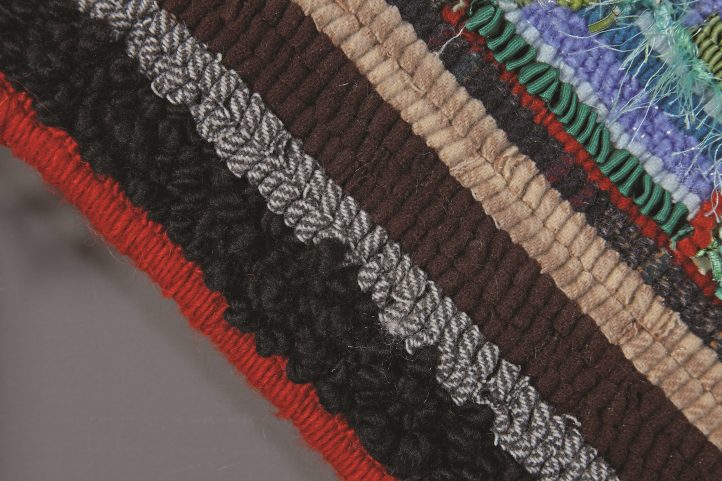
Carefully hooked rows border the piece in shades of brown to symbolize earth.
PHOTOGRAPHY BY IMPACT XPOZURES
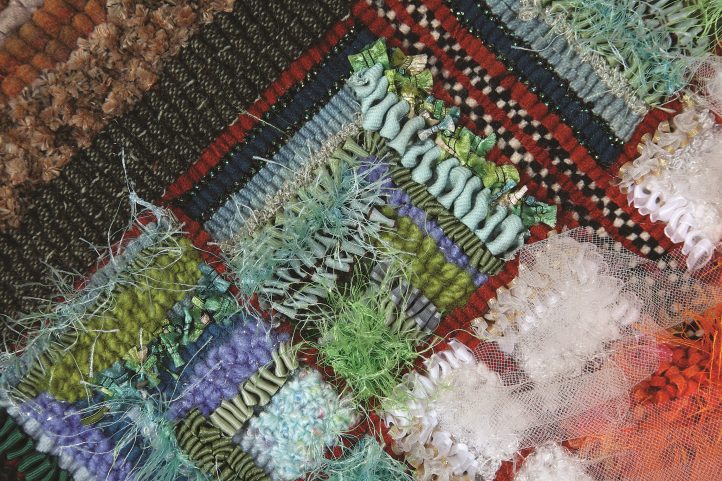
A variety of materials, including eyelash yarn, roving, and ribbon give the squares the feel of the four elements.
The Log Cabin pattern is an evergreen geometric that is perhaps one of the world’s most recognizable patterns. Used in many countries and traveling back and forth across many borders, the Log Cabin pattern’s ancestry is thousands of years old. This motif decorated the fabric that enshrouded mummified cats in the tombs of Pharaohs. In modern times, quilters have created hundreds of coverlets, blankets, and pillows with its variations.
For wool-and-hook artists, the Log Cabin is a prevalent puzzle pattern that goes back hundreds of years. Rug historian William Winthrop Kent, in his book The Hooked Rug, documents several very early 18th century rugs from Nova Scotia and other early rugs from America hooked in the Log Cabin design.
But this geometric pattern is not just a historical oddity. It continues to intrigue and challenge, catching the designing eye of rug hookers from Pearl McGown to Gene Shepherd. In 2009, the Mountain State Fiber Artists invited the Delectable Mountain Quilters to a rug hookers’/quilters’ challenge called “Don’t be Wooden About Your Log Cabin Designs.” My hooked creation, A Log Cabin God’s Eye, was chosen as the winning design. It measures 3′ x 3′ point to point, 2′ on each side, and is 7′ tall on its stand.
Researching the Symbolism
By tradition the Log Cabin pattern has been interpreted to represent the home. A red square inserted in the center of each block is said to represent the heart of the home: the fireplace. However, this charming interpretation is anecdotal and undocumented. The Log Cabin pattern is also thought by some to have been a charm that was meant to bring good fortune to farmers, as in some cases it resembles the patterns formed by plowed and planted fields. The Straight Furrows pattern is well known.
The symbolic inspiration of the design came from an academic religious discipline known as Sacred Geometry, also known as Nature’s Geometry. In this discipline, a square, with its perfect symmetry, represents unity and wholeness. The square, being formed by two pairs of perfectly equal yet oppositional linear elements (two sets of equal lines), thus graphically also fulfills the description of Universal Nature found in Taoism and other ancient philosophies. According to New Agers, the four sides of the square can be thought of as love, knowledge, power, and compassion.
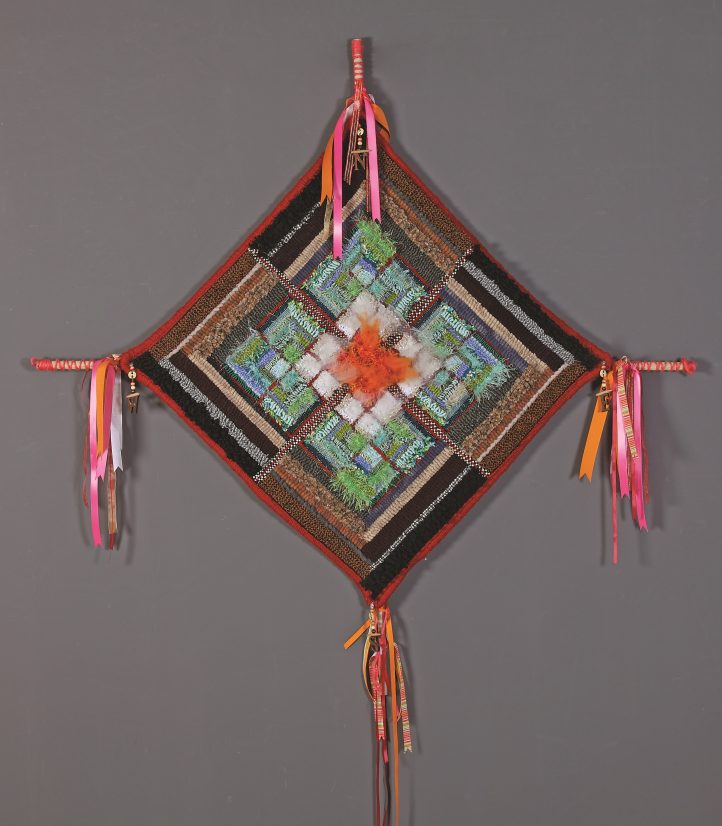
A Log Cabin God’s Eye, 3′ x 3′, #7-cut wool, yarn, and roving on linen. Designed and hooked by Abby Chapple, Largent, West Virginia, 2010. A riot of colors and textures, this three-dimensional piece, 7′ tall on its stand, won the rug hookers’/quilters’ Log Cabin challenge.
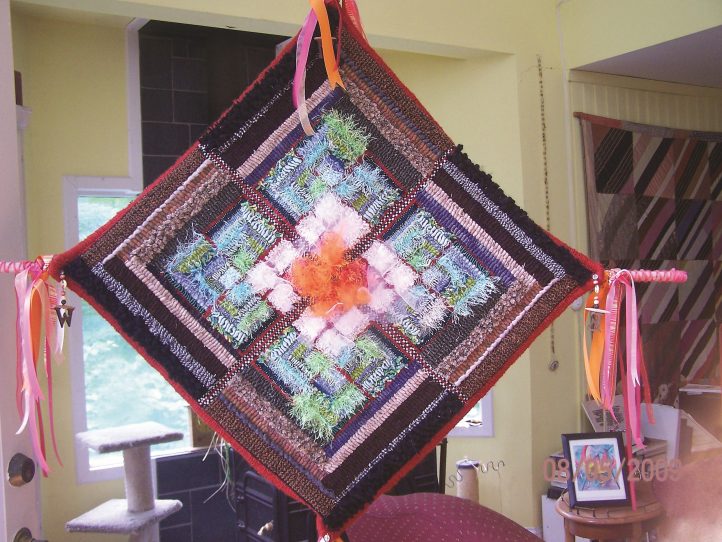
A snapshot of A Log Cabin God’s Eye in a room shows the scale of the finished piece.
With these ideas as a starting point, my Log Cabin design developed into a diminishing, four-patch square pattern that was turned 45 degrees to create a diamond shape evocative of the God’s Eye talisman, a yarn weaving on crossed sticks used as a ritual object by Mexican and Indian tribes. Each of the 20 to 40 squares within my design—depending on how you count them— follows the form of stacked logs used in the classic Log Cabin design, not the Courthouse Steps or other variations.
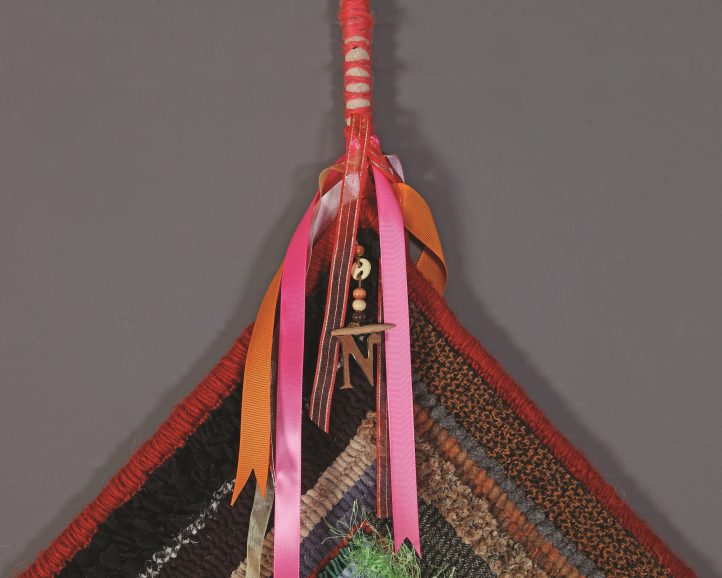
Ribbons on the corners of the mat are inspired by Native American designs.
In some Asian traditions, the square symbolizes the earthly realm bounded by the four directions, according to The Secret Language of Symbols by David Fontana. So in my piece, the four corners are accented with beads and the letters N, S, E, and W in acknowledgment of geographical orientation.
Defining the Shape
I began by sketching out ideas. The challenge “to not be wooden” led me to first research pictures of every Log Cabin design I could find. I wanted to know how they were similar and how they were different. To simplify my research, I looked only at the classic pattern.
My first observation was that the logs butted against each other in an interlocking pattern. My second observation was that the logs were stacked so the corners of the squares created a consistent, repetitive pattern. In most examples, the corners pointed northwest.
Of these two principles, the second—the orientation—showed the most variation. Some squares were simply fixed horizontally and vertically; others were arranged “on point,” tipped 45 degrees. I decided to use a tipped arrangement, and out of that developed the diamond shape known as the God’s Eye.
This decision, in turn, led to another question: How many squares should I use? Only four identical squares could point northwest, but I thought it was more interesting to have them point in the four directions: North, South, East, and West.
I decided to continue the sections in different colors in decreasing sizes. This arrangement provided me with the opportunity to choose a theme: the four elements. I chose to separate these elements and the internal squares with a fine red line. The main four patches were separated with a checkerboard pattern.
Choosing Colors and Materials
The four elements—earth, water, air, and fire—reflect my strong environmental background and led to my next choice: what colors I would use. I chose muted browns, tans, and grays for earth; blue for water; white for air; and red for fire. This meant that, by happy happenstance, if I placed the red for fire in the smallest center square, I would be echoing the idea of the fireplace as the center of the home.
I find great joy in the visual impact of texture and the feel of different materials as I work. So I went on a scavenger hunt. I ruffled through my stash of uncut wool fabrics, decided to use a #7 cut, and then serendipitously thought of adding yarns of all sizes to give the piece variation in surface height.
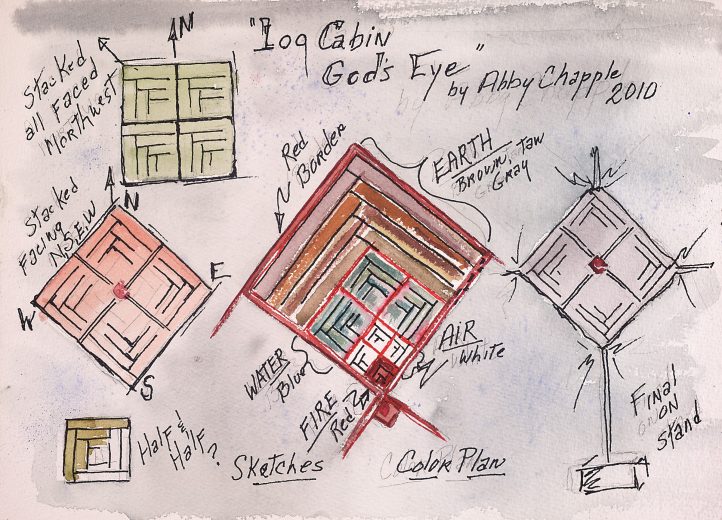
Study and lots of sketches took place before hooking began.
Finding the browns was no problem—hundreds were readily available. I finally chose four bands of different widths on one side and five bands of different widths on the other side.
Selecting blues to represent water proved to be more of a challenge. Although hundreds of blue wools were available to me, I wanted sparkling water. I found lots of possibilities in the ribbon sections of craft stores and mixed them with a novelty eyelash yarn.
Since we really can’t see air, I thought about hooking it with cellophane, but I couldn’t find an appropriate transparent material. Instead, I thought of clouds—and finally this section began to work. I shopped in a fabric store until I found the filmy, lightweight netting used in bridal veils. Thinking again of texture, I pulled the netting up high, to about 4″.
For fire, I combined yarns, including the eyelash yarn, and roving. Since fire is made up of many colors, my red included a lot of oranges. I took a lot of time working with the materials so they would look like rising flames.
While hooking, I didn’t do anything different when working with yarns and ribbons than I do when hooking with wool strips. I used prodded stitches, or proddy, for the white veiling and red roving.
Holding It All Together
The structure that holds the mat is simple: a cross of sticks just like the primitive God’s Eye. These two sticks are wooden rods from a hardware store held together at the center with a soft metal wire. I also used wire to attach the mat to the sticks. (I later added two vertical poles stuck in the wooden base to stabilize the project and make it free-standing.) I extended the ends of the horizontal sticks out beyond the edge of the mat and above the top point. Taking inspiration from Native American artwork, I laced the corners with colored yarn. Just for fun, I added a blaze of ribbons.
What started out as a simple project took on a life of its own, each element demanding more and more detail. Looking back on it, I found the spontaneous decisions and their unplanned results made this project more complicated than I had intended—and much more interesting. But this, I feel, is the true challenge of a rug hooking challenge. It leads us to new discoveries.