
 Give a Gift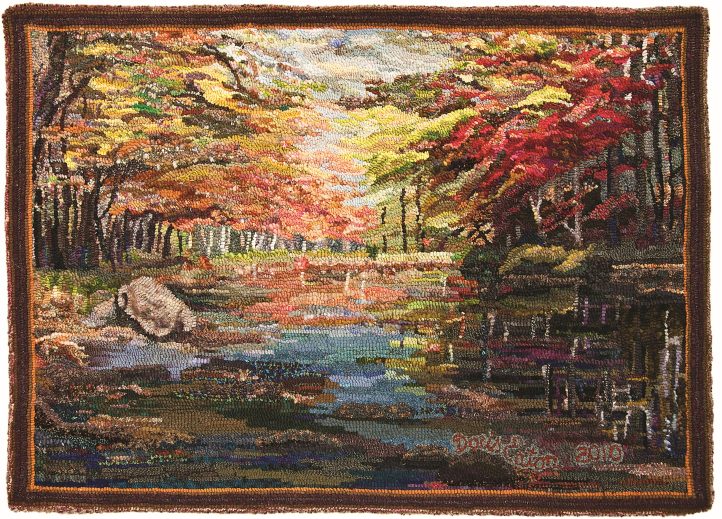
Petite Riviere, 38″ x 27″, wool strips on linen. Designed and hooked by Doris Eaton, Crousetown, Nova Scotia, 2010.
Doris’s impressionistic style captures the broken-color brilliance of autumn trees. Loop by loop, the colors she hooked brought to life the wide variety of autumn hues. The rock seen in mid-ground on the left was problematic enough for her to consider eliminating it entirely. But not one to back down from a challenge, Doris discovered that needle-felting a shadow over the rock was a way to provide the depth and texture she had been seeking.
The inspiration for this rug came from a pretty snapshot in Doris’s creativity journal. Asked to create a rug for a husband’s gift to his wife—both friends of the Eatons—Doris decided to hook the scene in the photo, which is located near her friends’ home.
Petite Riviere stands as one of Doris’s favorite rugs. Sparkling with autumn colors and alive with reflections in the water—depictions of atmosphere rather than details—this rug especially makes good on Doris’s philosophy of interpreting rather than copying nature. How does one decode a profusion of colors such as those seen in the foliage of the tree canopy? She points to the left-hand corner of the photo. “When I was ready to hook these, I looked closely at the colors in the snapshot (a 4″ x 6″ picture!) and then went into my studio and gathered a basketful of strips in these colors. I went back to my hooking and then just carefully hooked them in.”
PHOTOGRAPHY BY PETER BARSS
In her golden year of hooking rugs, Doris Eaton is widely regarded as the preeminent wool hooking artist in Nova Scotia, the standard bearer for generations of fiber artists to come. She is considered a cultural treasure of Canada’s Maritimes.
Not one to hook in the shadows, Doris has spent the past 50 years promoting the craft and art of rug hooking through teaching, mentoring, and public event demonstrations. She co-founded the Rug Hooking Guild of Nova Scotia in 1979, which, in keeping with its mission to provide continuing education to all rug hookers, has since sponsored two popular rug hooking schools a year. More recently she co-founded Art Hits the Wall, a biannual, theme-based show featuring the most creative quilts and rug hookings in the region. She also participates in the Square Zebras, a creativity group for fiber artists that exhibits frequently.
Doris’s rugs have won numerous blue ribbons and best in show awards. Her original designs have been chosen five times for Rug Hooking Magazine’s Celebration series. This summer, she celebrates her journey in fiber art in her first book, A Lifetime of Rug-Hooking. (Nimbus Publishing.)
Doris usually creates two or three large art rugs a year. With frequent themes of landscape, beach, and sea hooked in familiar Eaton style—impressionistic, painterly, and elegant—her compositions find admirers in both folk and fine art circles.
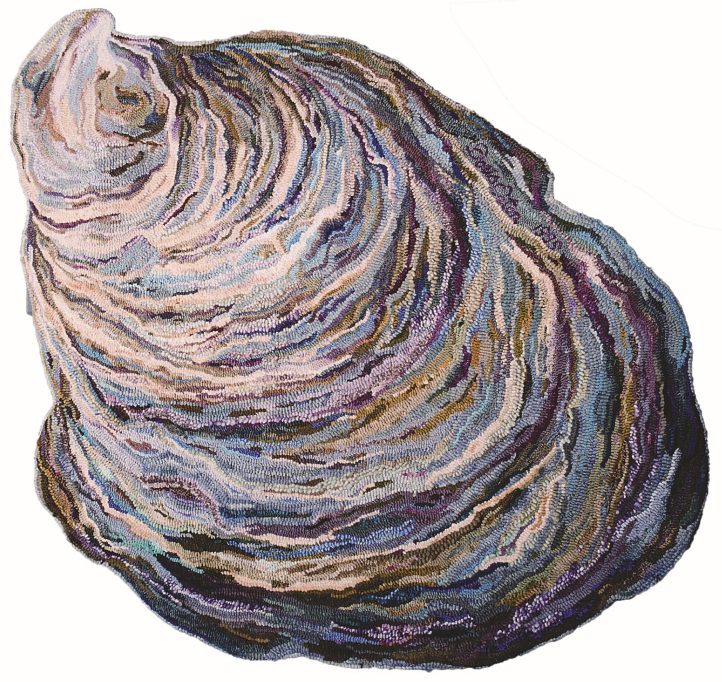
The Oyster, free form, 4′ at widest point, #5 and hand-cut recycled wool and fibers on linen. Designed and hooked by Doris Eaton, Crouse-town, Nova Scotia, 2008. Doris and her husband stopped at one of a large chain of supermarkets in Nova Scotia. After carefully studying the oysters in the seafood case before them, Doris asked the fishmonger if it would be all right to buy just one. “Just one?” the fishmonger asked. She said, “Yes. You see, I want it for hooking.” He went to the back, wrapped up the oyster, and handed it to her. When she relates this story she still finds it amusing that the fishmonger didn’t think her explanation strange at all. “He must have known someone who hooked!” she said, adding, “Ron ate this oyster and I hooked it.”
“Doris creates works whose appeal is universal, but which are instantly recognizable for their Nova Scotia roots,” says the owner of five “Doris rugs,” as he and his wife call them. “She is not trying to talk to us from some other place inhabited only by those with more exalted sensibilities. She sees what we see, but she helps us to look again, and see more each time.”
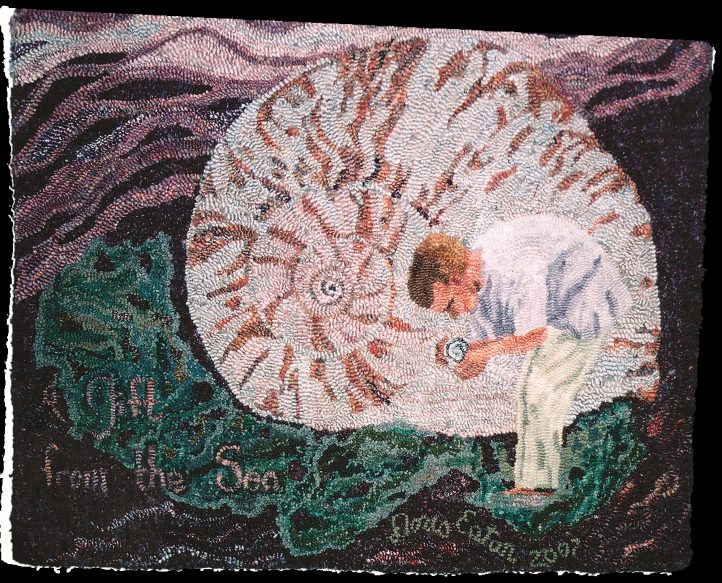
Gift from the Sea, 36″ x 23″, hand-cut dyed and found wools, hand-carded fleece, yarns, and suede on linen. Designed and hooked by Doris Eaton, Crousetown, Nova Scotia, 2007. The creative process behind this rug is explained in Doris’s creativity journal. She pasted in a print created by a friend who uses the surface of turnips on which to carve images. This particular print is that of a nautilus shell. Next to it is a photograph Doris took at a nearby beach of a young man stooped over to examine a treasure found on the sand. As both images merged in her mind, Doris intended to superimpose the two in a painting, but in the process found the better design of placing the boy within the larger shell. And finally—as she puts it, “It took a long time for that image to get out of my system”—her painting inspired a hooking.
Impressive list of achievements notwithstanding, what practitioners of the craft—as well as anyone involved in creative work—find most inspiring about Doris is that she exudes creative energy. Her artistic vision never seems to fade, and her curiosity keeps on keeping on. By her own count she has hooked more than 120 rugs. Most are original designs. Untold smaller hookings also carry her familiar scripted signature.
“Not following many rules” keeps her fresh, she says, laughing. “I like to try things that keep me out of my comfort zone,” she says.
By way of an example, she holds up a large piece of unhooked linen, sparsely and lightly mapped with marker. As yet, the image is indiscernible. A photo reference lies nearby.
She points to broken ice in the photo and wonders, bemused, “Now, how am I going to do that? I have no idea. I’ll have to play with it, try different things, and be creative about how I work that out. And I think that’s the most exciting part. I’m going to work at it until the problem is solved,” she says. “It’s a matter of starting maybe again at the beginning and figuring out where I want to go with it and maybe that gives me direction. Scribbling, doodling—just letting things happen that work.”
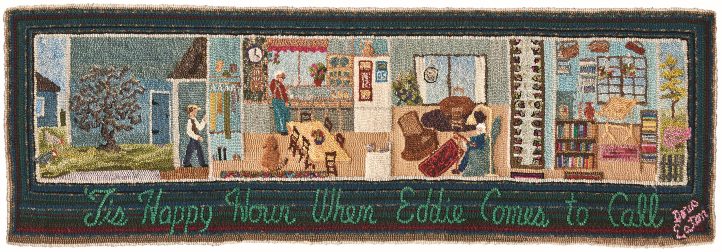
’Tis Happy Hour When Eddie Comes to Call, 65″ x 21″, #5-cut recycled wool, fibers, and pencil roving on linen. Designed and hooked by Doris Eaton, Crousetown, Nova Scotia, 2005. Doris “quotes” the Grant Woods painting, “Harvest Time,” in this charming paneled piece that tells the story of a beloved neighbor whose ritual brings him to their doorstep at a specific time of day. Eddie is a special neighbor who visits three times a week to share some late afternoon conversation with Ron while Doris, as pictured, contents herself with some quiet time by herself, “getting lost in my hooking.”
Doris is nothing if not tenacious. Her way of creating a hooked image is to lay in the elements: shapes and mass, lights and darks. This process, with its minimal commitment to final design, provides opportunities for discovery. Organic, it grows from within, dictating texture and color along the way.
She explains that her interest lies in interpreting nature, not copying it. And this is perhaps how her craft becomes art: an image created by Doris invites the viewer’s imagination into the experience, thereby providing a more personal link between creator and observer.
Though her work has long been a fixture at hooking shows—including a number of one-woman exhibits—she had to persevere to get her work shown to a wider audience of art lovers. Partly as a result of her determination, hooked rugs have finally begun to poke through the glass ceiling of fine art and craft galleries. She has helped change the public perception of rug hooking from craft to fine craft, from folk art to fine art.
But accolades aside, the real excitement for Doris Eaton lies where it always will be found: in the image that’s about to emerge from the lightly marked linen stretched right now on her frame.
TIPS FROM A MASTER
- Break the rules and make it your own, your way.
- Don’t plan too much detail. Let the textures and colors say it for you.
- Draw in only the key elements; let your hooking fill in the details as you go.
- If you’re eager to grow, try something different.
- Choose colors that appeal to you, whether they are actually in the scene or not.
- Emphasize the darks and the lights—contrast is very important!
- Strive for an impression, not realism.
- Regarding exhibits: Given the slow process of hooking, the best way to attract attention (from a gallery or other venue for exhibit) is by working as a group on a theme.
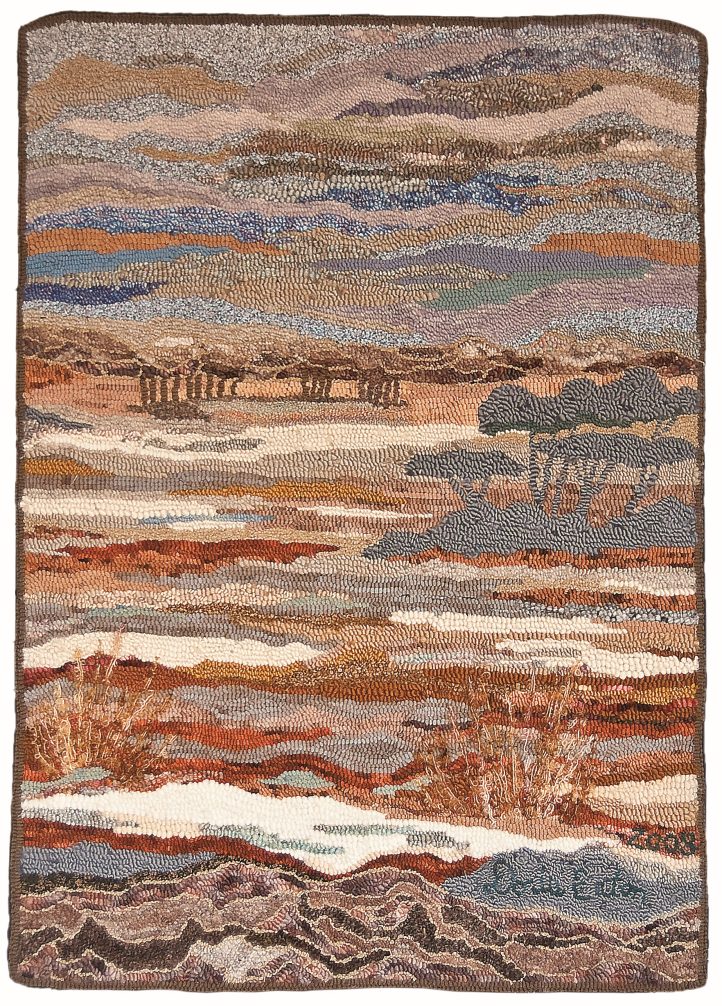
Spring Thaw, 29″ x 40″, recycled wools, fabric, sweaters, and roving on linen. Designed and hooked by Doris Eaton, Crousetown, Nova Scotia, 2008. Born and raised in Massachusetts, Doris says that she still misses New England springs. Spring Thaw was hooked in March, when it seemed that the winter would never end and the ice and snow would never thaw. She hooked with whatever materials would give her the colors she needed; much of the wool had been precut for other projects. The sky was hooked in #5 and #6 cuts. She found a nice skein of yarn for the nubby look, which was sewn on after the hooking was completed.
A QUEST FOR CREATING
Doris Eaton was born in Boston, Massachusetts, and was accepted to the Massachusetts School of Art as a painter in 1946. She would later marry Ron Eaton and move to Nova Scotia where they raised five children, ran a farm, and operated a bed and breakfast. Doris studied rug hooking under Edna Withrow of Wolfville, Nova Scotia, for eight years. To Doris, it was Mrs. Withrow’s vision that bespoke refinement in a craft that has otherwise been regarded as a humble pastime. Even though Doris would continue to paint, from that point on, the hook trumped the brush. Today, she and her husband live along Nova Scotia’s ocean coast in a cottage that they refurbished 25 years ago. It stands close to the road behind a natural picket fence and in front of acres of home-grown fruit trees, blueberry bushes, gardens, and a koi pond.
From her childhood: An especially sweet memory is that of her mother bringing her grandmother a new stamped pattern to hook during the winter months. She recalls the delight on her grandmother’s face when she opened the new pattern, rolled as it was around pieces of materials saved for the hooking. You can imagine, as you listen to this story, the excitement the next visit would bring as the pattern of the previous summer was now showcased on the floor.
A traveling salesman was able to persuade Doris’s grandmother to barter all of her rugs for wall-to-wall linoleum. Imagine the conflicting expressions on the faces at the time: Doris’s grandmother proud of her new linoleum while at least one granddaughter, Doris was grief-stricken over the loss, forever, of grandmother’s beautiful handwork.
On hooking during busy times: When her children were younger, Doris instituted what she called “My Wednesday,” a weekly time-out just for art. “I cooked ahead for the day and the children would spend extra time in their playpen or with toys they hadn’t seen in a while. My friends knew not to call me on that day, too.” Her special day apart continues today.
On rug hooking: Given her achievements and awards, people might be surprised by her willingness to share her methods, her tricks, triumphs, and techniques. She is not one to cloak her work in mystery. To be around her is to know that art, for her, is about communication. She doesn’t take appreciation for granted; it still seems to delight and surprise her.
“Doris shows her rugs as if it is her first hooked piece, with the joy and delight of a child showing his or her precious glee in doing something beautiful and sharing it,” notes her friend, Judith Dallegret. “[She] teaches without even saying anything—just by her curiosity and courage to support you. She is always on a quest for creating—for herself and others equally.”
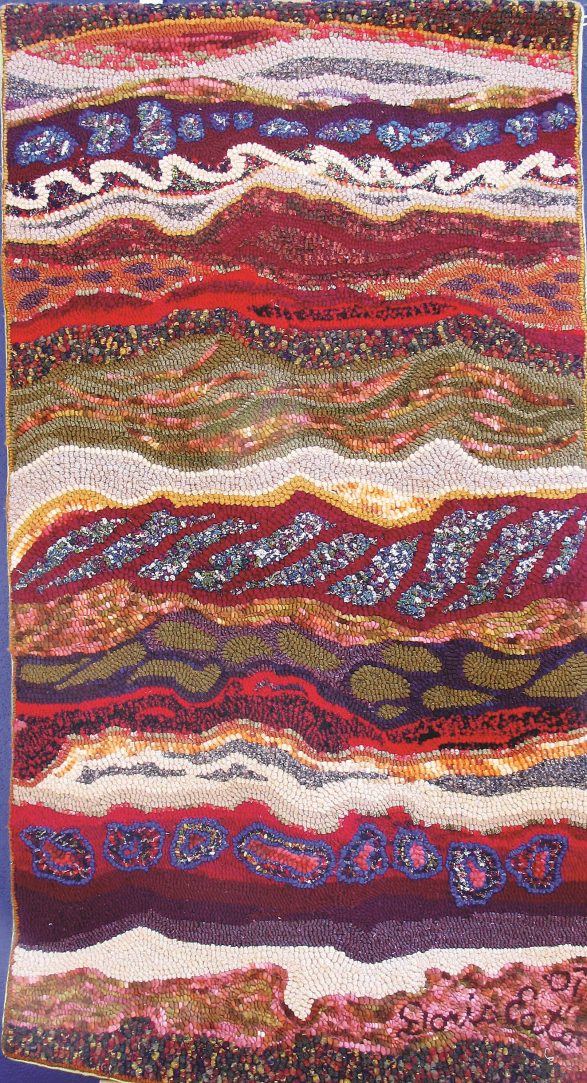
International Runner, 52″ x 28″, hand-cut sweaters (about #7- or 8-cut) and roving on linen. Designed and hooked by Doris Eaton, Crousetown, Nova Scotia, 2007. HARVEST GALLERY, WOLFVILLE, NOVA SCOTIA. This rug is named cleverly for the geographical diversity of its fiber content—sweaters bearing labels from all over the world though found at one place: Frenchys, the thrift store chain that’s a beacon for Maritime hookers and shopaholics alike. With little further preparation or shrinking, Doris hand cuts sweaters across the body, usually parallel to the ribbing along the bottom. Of late, she has used a similar design motif in other pieces—she calls them her “stripey things”—which, amused, she allows to be called “her signature,” if only for the time being.