 Give a Gift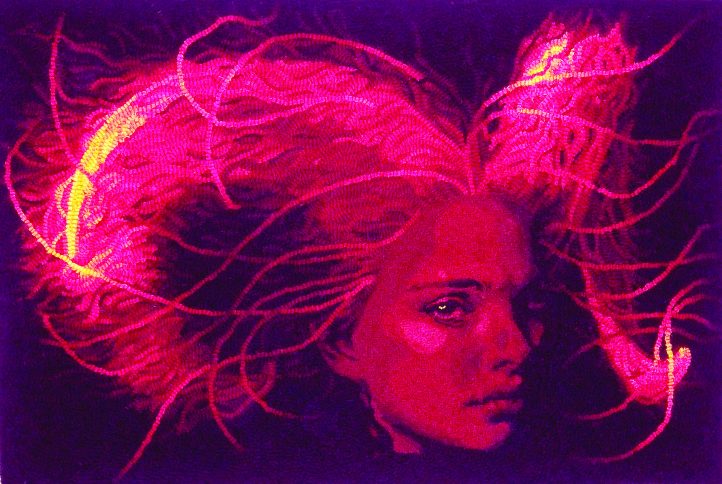
Aries, 26″ x 18″, #2- to 4-cut hand-dyed wool on linen. Designed and hooked by Mariah Krauss, Montpelier, Vermont, 2011.
TRADITIONALLY THE ZODIAC CALENDAR BEGINS WITH THE VERNAL EQUINOX, SPRING
The Zodiac: twelve constellations, twelve equal zones around the ecliptic (equator), horoscope, astrology, sun signs, and seasonal birth signs . . .
All over the world people look to the stars for answers and guidance. Throughout history, the Zodiac relates symbols of star constellations to human traits.
For this stellar, earth-bound representation of the Zodiac, fiber artists across the globe were invited to create original hooked rugs based on the Zodiac symbols. Each piece had to measure 18″ x 26″ and could be either a vertical or horizontal format. All ranges of cuts, a wide variety of materials, and interesting techniques are featured in the twelve works. Subtle symbols, obscure myths, and personal interpretations created the compositions. Several artists chose to use particular techniques or materials popular in their region. Many used the assignment to problem-solve a design challenge.
As with all hooked rugs, a story lies behind each work of art. Enjoy this colorful, creative reinterpretation of the Zodiac in fiber.
Aries, the Ram
21 March to 20 April
Mariah’s design (see above) came about as if from a dream. “It may be an idealized self-portrait, or a portrait of any Aries woman.” Fire is the element ruling Aries, so Mariah created a giant swatch of fire colors in the dye pot. She envisioned flames of fire for the hair and then realized shaded ram’s horns would accentuate the wild, free, and slightly dangerous and unpredictable characteristics of the sign. Mariah immersed herself in the piece, sometimes sitting back with patience and studying it, listening for direction rather than preplanning the project. The exuberance of youth is evident in her finished work. Mariah is a fifth-generation rug hooker, following in the dye pots of her mother Stephanie Allen-Krauss and grandmother Anne Ashworth of Green Mountain Hooked Rugs.
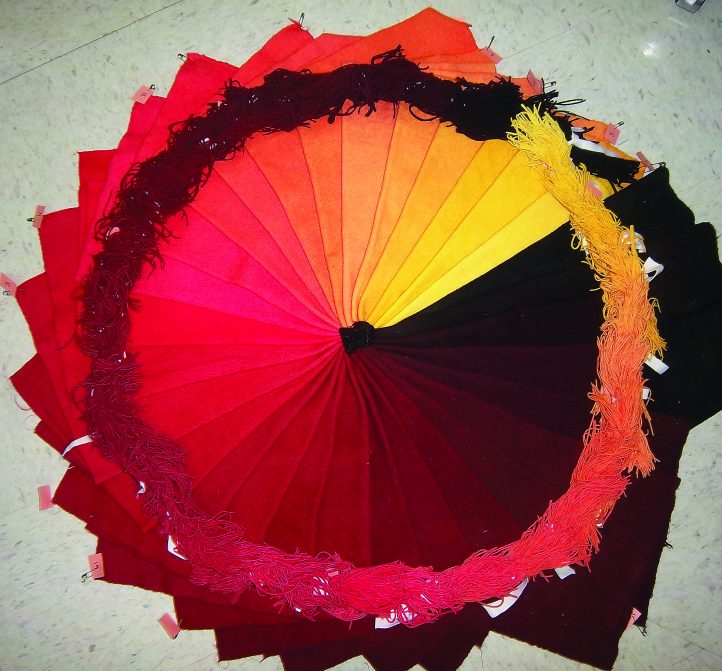
Fire colors dyed by Mariah Krauss for Aries.
Taurus, the Bull
21 April to 20 May
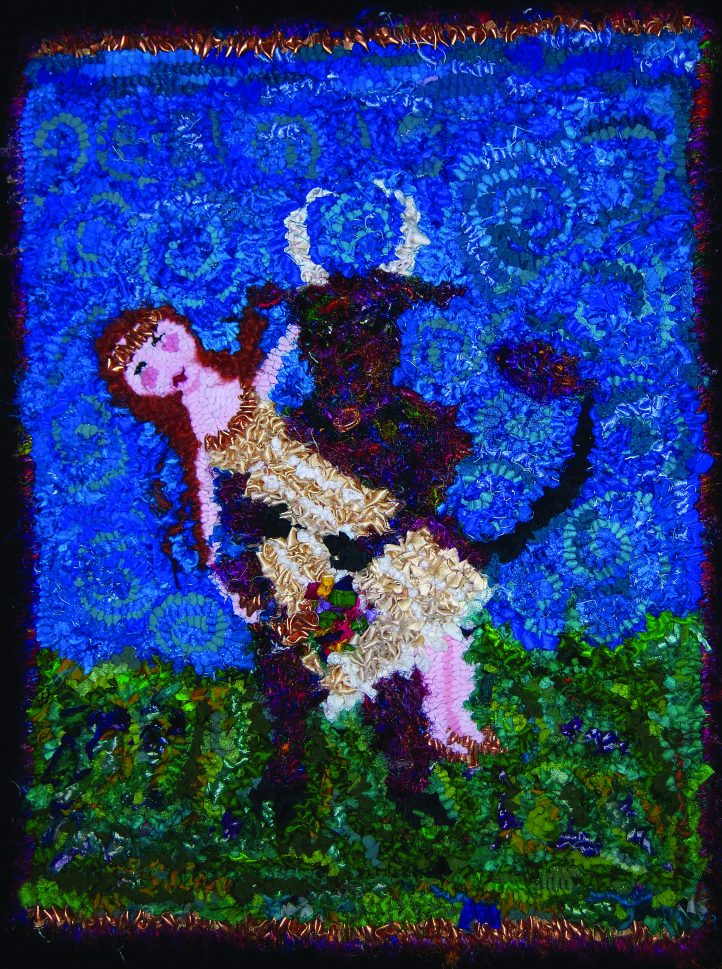
Spring Nuptials: Taurus Takes a Wife, 18″ x 26″, hand-cut sari silks, silk yarn, nylon stockings, and metallic material on rug warp. Designed and hooked by Patti-Lynne Armstrong, South Zurich, Ontario, Canada, 2011.
Appropriately titled, the design has a dreamy feeling reminiscent of a Chagall painting depicting a wedding with a goat playing the violin. Patti is allergic to wool yet fell in love with pulling loops through a backing to make rugs and art several years ago. She earned a teacher’s certificate through the Ontario Hooking Craft Guild using alternative materials for all the skills. The sari silks were difficult to pull through and form loops due to the wider hand cuts, but the shimmer of silk and the jewel colors made the effort worthwhile. The silk yarn was easier to manipulate, pulling through very smoothly and adding a whimsical, free feeling to the grass and whipped edge. The bull is hooked using the smooth silk, too. Copper metallic material complements the blue sky (orange and blue are complementary colors, or opposites, on the color wheel).
Gemini, the Twins
21 May to 20 June
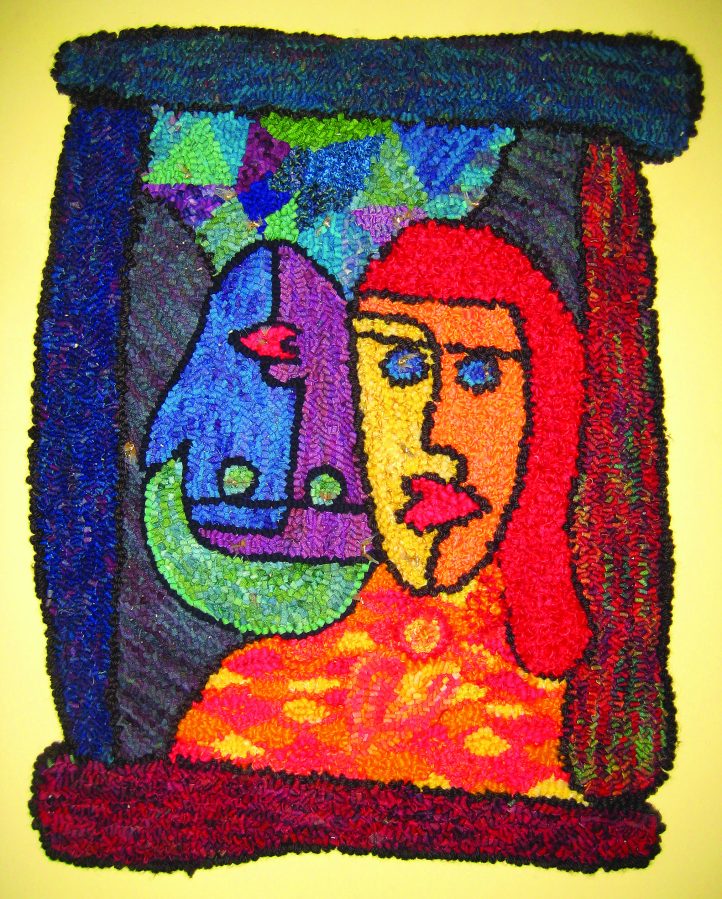
Gemini, 18″ x 26″, yarn, #5- and 6-cut wool, and other materials on monk’s cloth, mounted on matte board. Designed and hooked by Sara Judith, Nelson, British Columbia, Canada, 2011.
Sara is a certified Oxford punch needle instructor and a traditional rug hooking artist. The contrasting symbol of twins, or opposites, is interpreted here by using both hooking and punching. She also split the design into warm and cool colors, flowing lines and angular lines, and used yarn and cloth strips. The constellation is hooked in shiny fabric in the background (not evident in photo reproduction). Look for the graphic symbol for Gemini in the irregular border. The border posed a finishing challenge that Sara overcame by cutting a piece of thick matte board the size of the work and lacing the extra backing around to fit. Sara says she enjoyed the challenge. This stylized design is different from her usual pictorials, several of which have been Celebration finalists.
Cancer, the Crab
21 June to 21 July
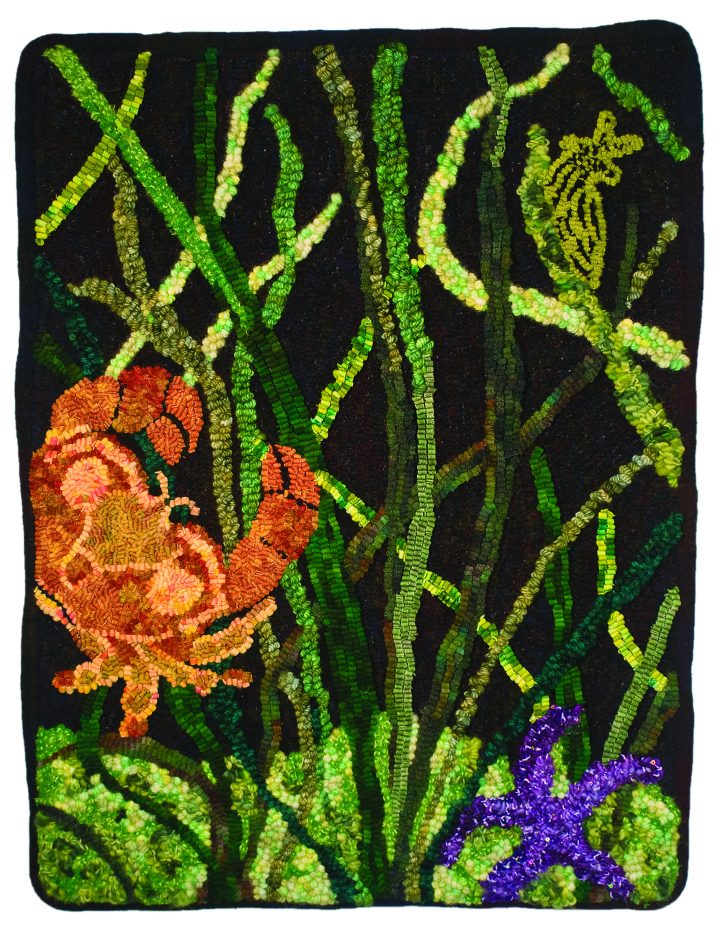
Cancer, 18″ x 26″, #6-cut wool and yarn on linen. Designed and hooked by Diane Learmonth, Anacortes, Washington, 2011.
A trained marine ecologist, Diane translated her sign using the local sea creatures of the Pacific Northwest. Dungeness crab, eel grass, a blue starfish, and sea slug all happily coexist underwater amidst the flowing grasses. The crab is Cancer’s symbol. Diane used yarns to soften the ground, and a harsh ribbon makes the surface of the starfish quite realistic. Diane and her family spend extended vacations on the waterways between Seattle and Alaska, and her hooking portrays calmness on the sea floor not often seen from above.
Leo, the Lion
22 July to 22 August
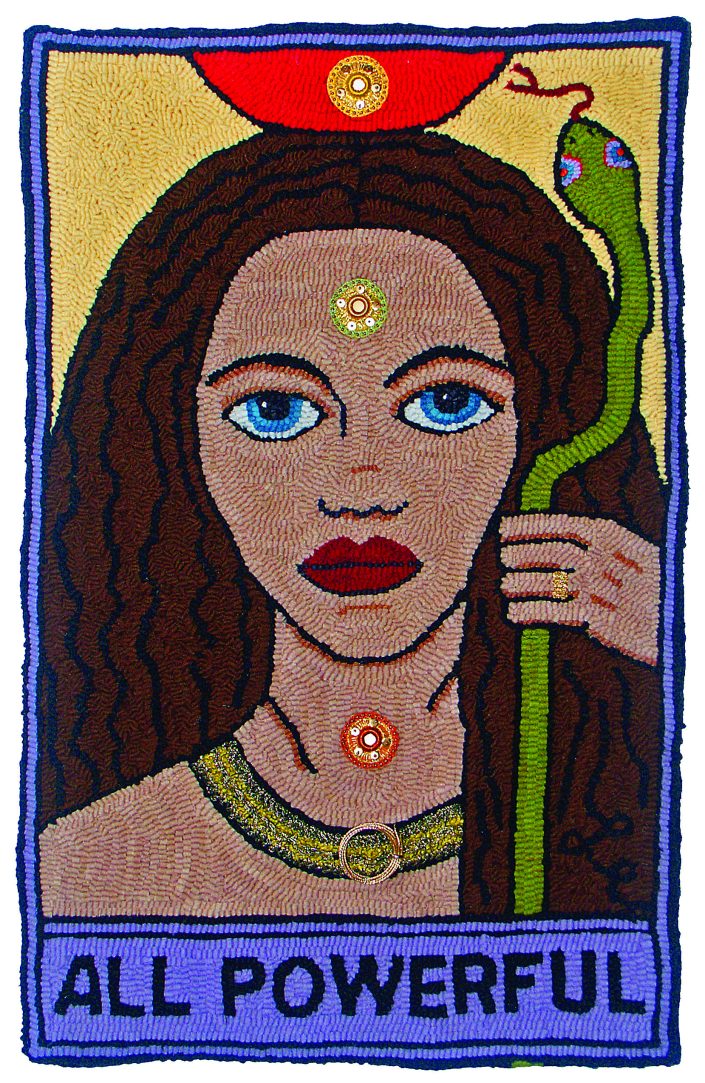
Leo, 18″ x 26″, various cuts of recycled fabric, embellished with beads, machine embroidery, ribbon, and a metal pin on linen. Designed and hooked by Linda Rae Coughlin, Warren, New Jersey, 2011.
In keeping with her ongoing series incorporating women in designs, Linda Rae portrayed the counterpart to Leo, a sun goddess. Her character possesses a noble manner (looking straight at the viewer, with an upright pose) that portrays authority, leadership, and peace. The element of fire is signified by the orange sun disc above her head. She carries a snake scepter for bravery and is titled “All Powerful,” drawing attention from and giving comfort to viewers. The bold design is emphasized by outlining all the motifs with a dark color. Linda Rae includes minimal facial lines for emotion and introduces waves into the mass of hair. The periwinkle color in the label is carried around as a thin frame, containing the character’s energy.
Linda Rae Coughlin is influential in promoting contemporary fiber arts as curator of international exhibits; she is an author, lecturer, and award-winning fine artist.
Virgo, the Virgin
23 August to 22 September
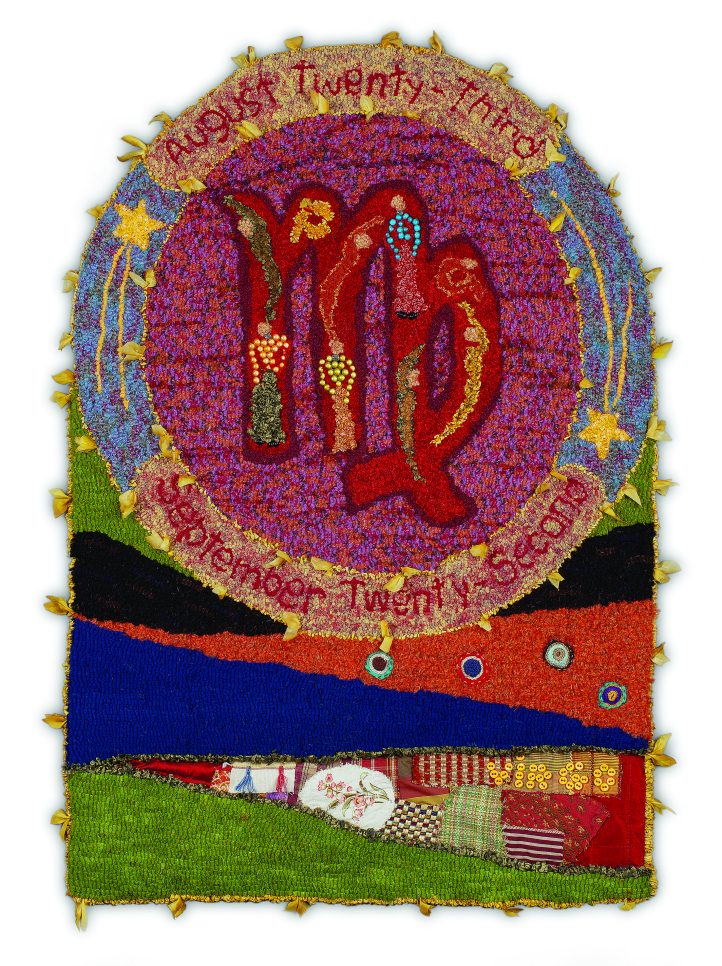
Virgo, 18″ x 26″, #5- and 6-cut wool, yarn, beads, fabric, and buttons on linen. Designed and hooked by Francine Even, Norwalk, Connecticut, 2011.
Francine is a Virgo, and she researched the graphic symbol and virgin symbolism for her design. In her design she incorporated the dates, symbol, earth element, and several women hidden within the central motif. Many fiber arts interest Francine; over the past four years rug hooking has entered her life. She finds the meditative and manual creativity pleasurable. Although she struggles with improving techniques, the joy in working with color and texture relieves the stress of striving for perfection.
This design posed several challenges. The shape mimics a typical circle with symbol inside, yet the foreground reminds us of earthly fields layered with hooking, and the collaged fabrics anchor the ethereal women. Her palette includes quiet, solid, dark-colored shapes intermingled with textured fields, which move our eye upward. The energy of one star falling and the other shooting up enliven the composition. The patterned finish adds a sense of freedom.
Libra, the Scales
23 September to 22 October
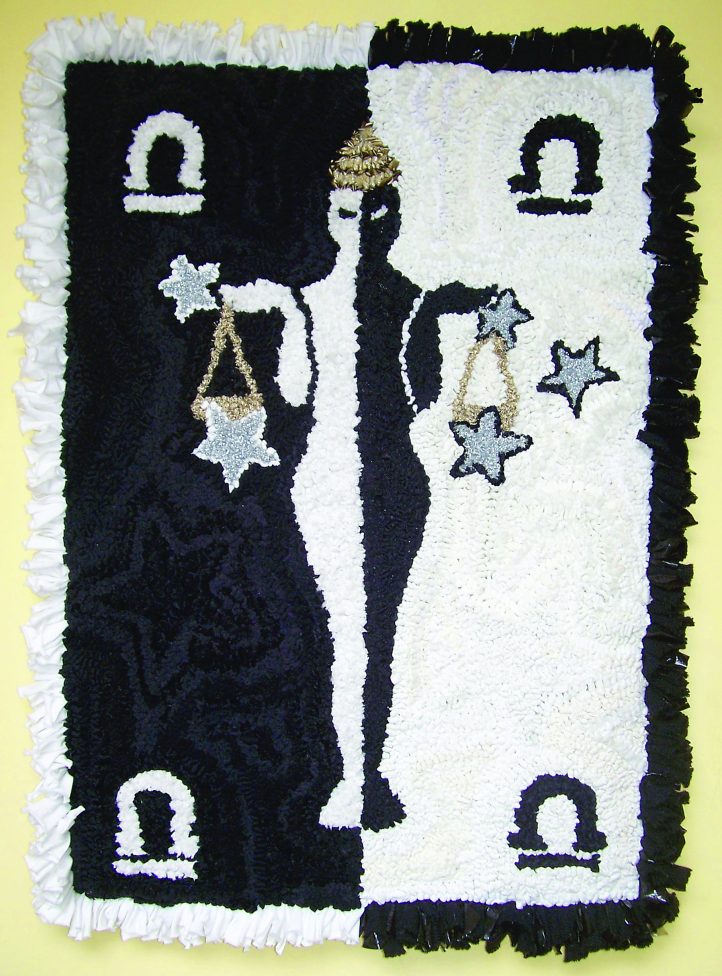
Libra, 18″ x 26″, #8- to ½”-cut wool, nylon sweatshirts, lacy underwear, velvet, Lycra, and plastic bags on hessian. Designed and hooked by Yvonne Autie, North Creake, United Kingdom, 2011.
In preparing to create her design, Yvonne researched Libra and discovered that scales and balance were prominent. She divided the work in half vertically, composing a body holding scales with the constellation in the background. Using a stark palette of white and black posed practical problems: the white sweatshirt fabric picked up black fluff if hooked first. She changed to a stretchy lacy underwear material, which resisted the fuzz. The small details were difficult to hook in recognizable form and were redone several times using different widths and materials. Note that the Libra symbols are the same sizes in white and black, yet the white ones seem larger because of the white’s intensity against the black. In the background of both she hooked a larger star; it is most visible on the black side. The edge is prodded with 3″ knitted material and plastic bags to soften the harsh design elements.
Scorpio, the Scorpion
23 October to 21 November
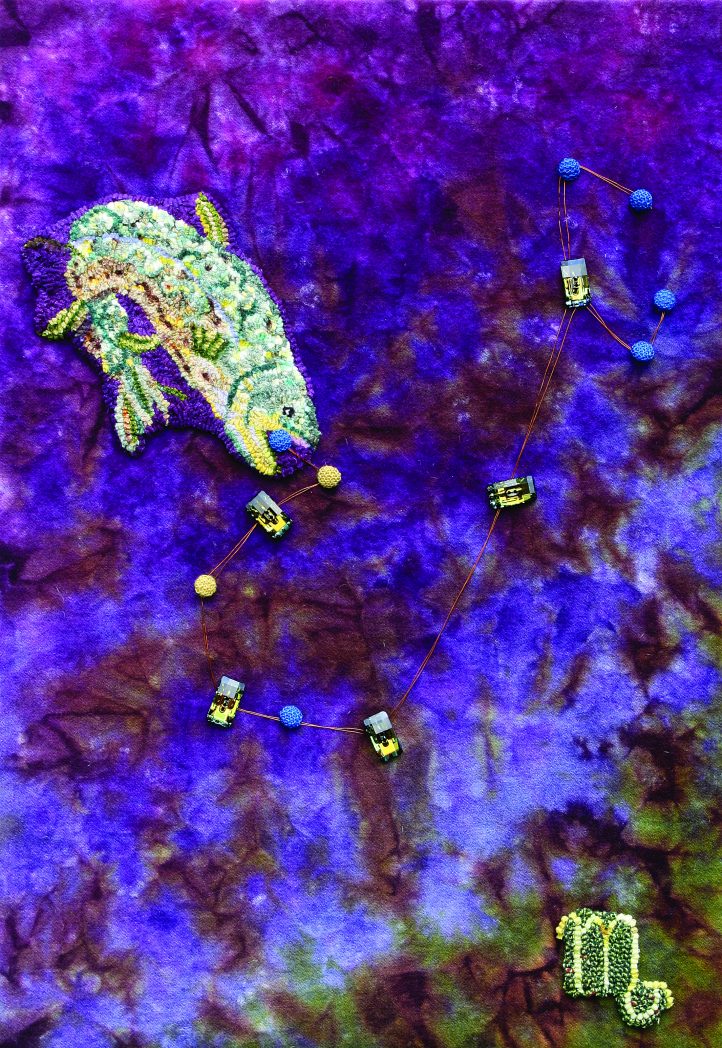
Scorpio, 18″ x 26″, #3-, 4-, and 6-cut wool embellished with crystal and crocheted buttons, copper wire, and hand-dyed wool, stretched on matte board. Designed and hooked by Susan L. Feller, Augusta, West Virginia, 2011.
Scorpions are mysterious. This design commemorates a little known myth. New Zealanders are told the constellation Scorpio was a fish hook that grabbed the North Island and pulled it close to the South Island. Susan is known to procrastinate, so she was thrilled to remember a hooked leaping fish already in her unfinished projects pile. She used a yard of gorgeous hand-dyed wool purchased from Wanda Kerr three years earlier for the celestial sky and earth element. To give the far-off effect, she did not cut any of the fabric but used it as one solid piece. She hooked around the fish with a dark purple, glued the backing, then turned under the edge and hand stitched it in place in the yardage sky. Then using large prism buttons for the brightest stars, she stitched through the fabric and foam core backing, anchoring the fabric and heavy buttons. She selected blue and yellow old crocheted buttons to attract the eye, and emphasized the fishhook constellation by connecting the buttons with two rows of copper wire. The design seemed unbalanced until she hooked the symbol for Scorpio in yellow in the bottom right. It reads as a signature and directs the viewer’s eye to the earth. The fabric is laced around to the back, tightening it across the foam core.
Sagittarius, the Centaur
22 November to 21 December
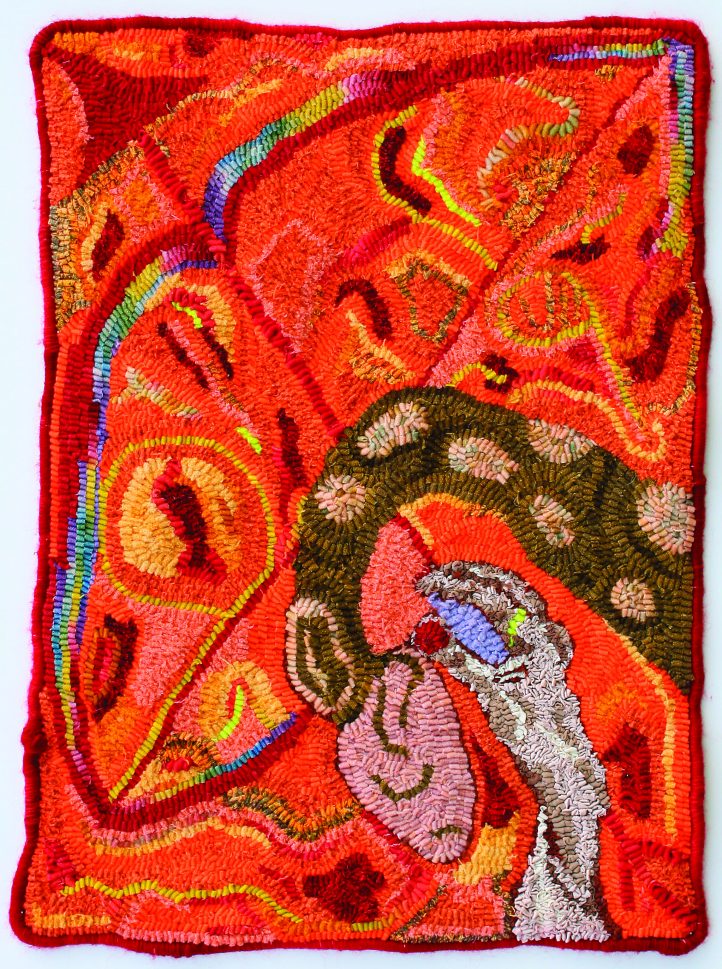
Sagittarius, 18″ x 26″, hand-cut new and recycled wool and yarn on linen. Designed and hooked by Jennifer Larmour, New York City, New York, 2011.
Jennifer is new to colors and textures: she came to rug hooking as a pen and ink artist. Random and spontaneous shapes break up her overall designs, adding depth and energy. Her sun sign is Sagittarius, and she identifies with the symbolism. The centaur (half-man and half-horse) is depicted with the horse leg and human hand. The hand has magic dust, which will be sent out via the red arrow (fire). The orange background, symbolizing fire, was an exciting dyeing experience for Jennifer; she mentioned the need to release control while in the dye pot and wait for the results. A rainbow strip of wool in the arrow stands for Sagittarius and the ring is on the Jupiter finger (the planet of Sagittarius). All of the wools are hand cut; Jennifer enjoys this simple step and economical approach to rug hooking. She uses the craft as therapy from her stressful job, preferring to hook with a pile of wools as she had drawn in the past, making shapes and tying them together with backgrounds.
Capricorn, the Goat
22 December to 20 January
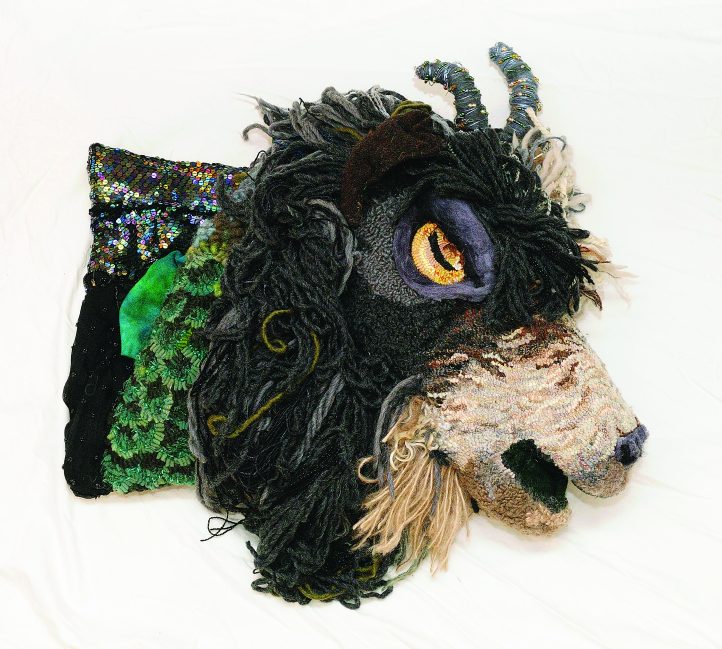
Capricorn, 18″ x 26″, wire, roving, wool fabric, yarns, crystals, embroidery floss, and recycled sequined dress on linen backing. Designed and hooked by Natasha Chan, Carmel, Indiana, 2011.
Taxidermy is one of Natasha’s interests. She has been watching Mounted in Alaska on television and used that inspiration as she studied articulated teddy bears and soft doll making to learn how to construct a three-dimensional goat. The head is three separate pieces: matching sides, and a middle bridge. The three pieces needed a continuity of fur colors. The eyes were hooked individually, stuffed, and sewn onto the head. Needle-felted roving surrounds the eyes, and the locks of hair cover the seams. She felted the nose then attached it. The mouth has a wire perimeter so it can open and close! She hooked the neck and mounted the head, as a taxidermist would, to the base. The head is heavy and needs internal support.
Aquarius, the Water Bearer
21 January to 19 February
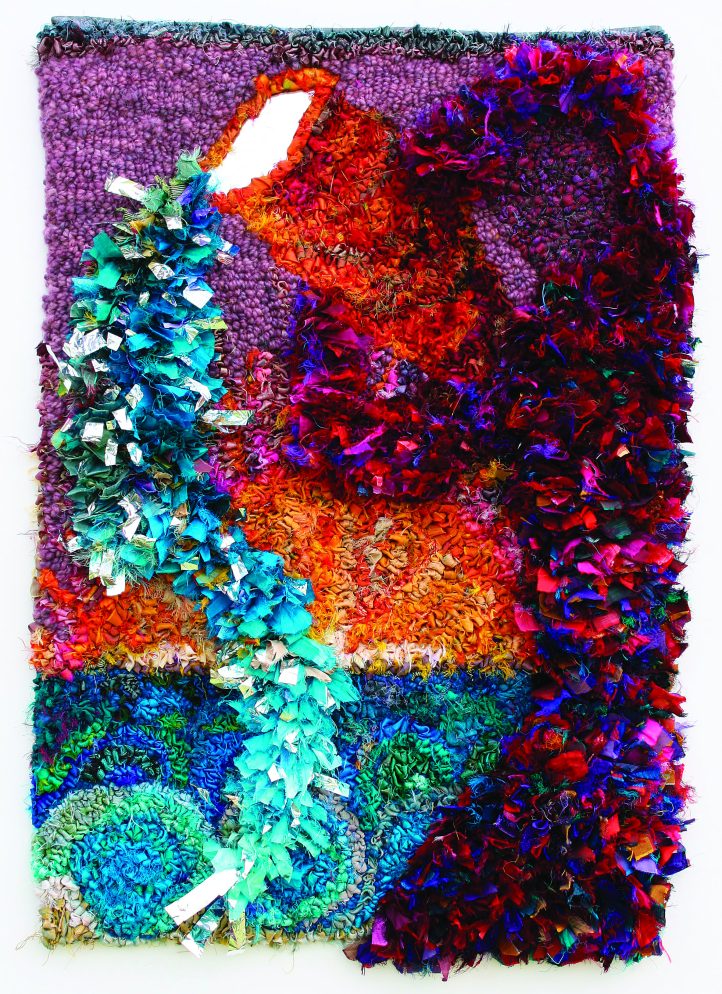
Aquarius, 18″ x 26″, silk sari ribbons, mirror, Mylar, and yarn on monk’s cloth. Designed and hooked by Jo Franco, Perth, West Australia, Australia, 2011.
Yards and yards of silk sari cut-offs were Jo’s inspiration, and these colors looked psychedelic, reminding Jo of the song, “The Age of Aquarius.” Jo ironed the saris to extend the amount of fabric and accent the colors (a frugal Australian approach to all fiber arts). To portray pouring water, Jo used wide strips of recycled Mylar tape prodded through in long strips to flutter and reflect the light. The strips emerge from a real mirror, which is anchored with overcast stitches around the edge. She would in hindsight suggest gluing the mirror to the backing fabric.
Like many artists, Jo has no trouble critiquing her own work after she has finished. Jo prodded the female form because she wanted to show off the reds and purples. Now, she feels this shape should have been hooked with the fabric and the face prodded or sculpted. She also believes the jar, which is the main symbol, should have been featured more. If it had been sculpted and shaded, with the mirrored opening and Mylar spilling out, the story would have been better illustrated. Jo observes that if she had sorted her materials into values rather than concentrating more on the colors, she could have shown the elements better.
Pisces, the Fishes
20 February to 20 March
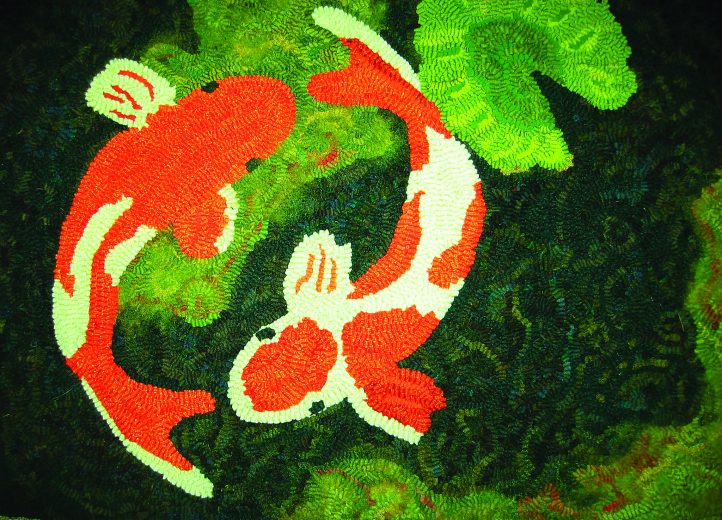
Pisces, 18″ x 26″, #7-cut hand-dyed wool and roving on linen. Designed and hooked by Andrea Sheppard, Aurora, Ontario, Canada, 2011.
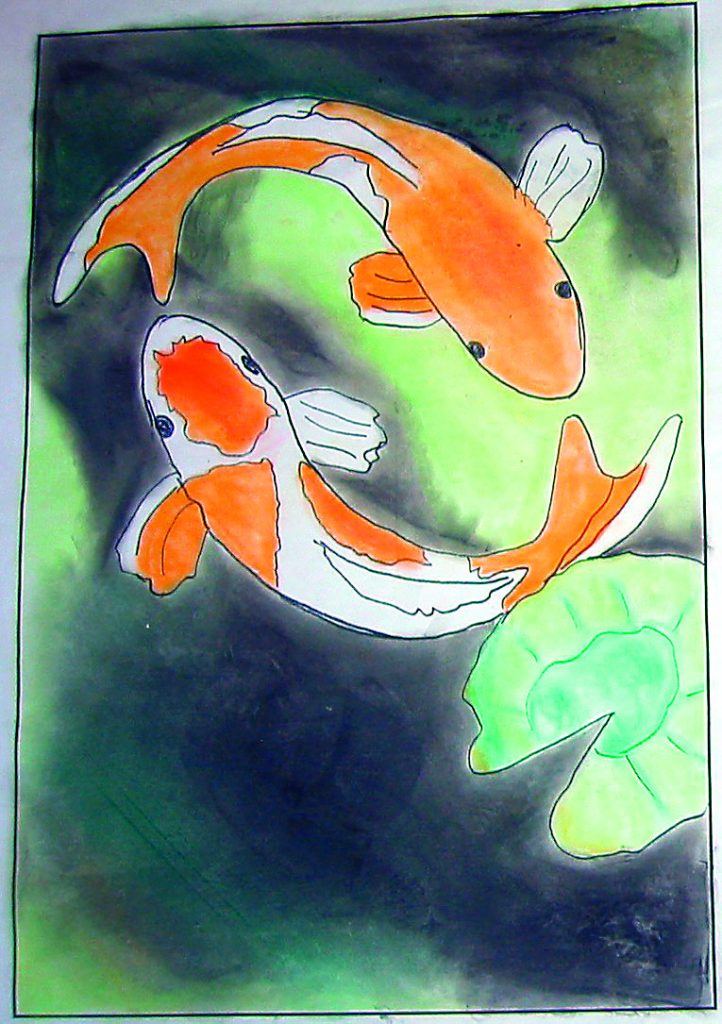
The colored pencil sketch shows Andrea’s initial design. The position of the two fish swimming in opposite directions symbolizes the internal struggle of the soul. They form a circle representing life after death (or from the struggle). Her image can be viewed from any angle, and without a definite border, the viewer seems to be looking down into the pond. A murky, dark water with layers of fish below the two prominent ones and water lily pads as quiet places called for hand-dyed wools. Since the design had been sketched—and color planned—prior to hooking, Andrea knew it well. Small details such as the dorsal fins and scales were eliminated to portray the ethereal simplicity of the subject.
She achieved the distinction of different objects within a close color palette by varying the values and by directional hooking. Softening the plant material with loose needle-felted roving emphasized the textures.