
 Give a Gift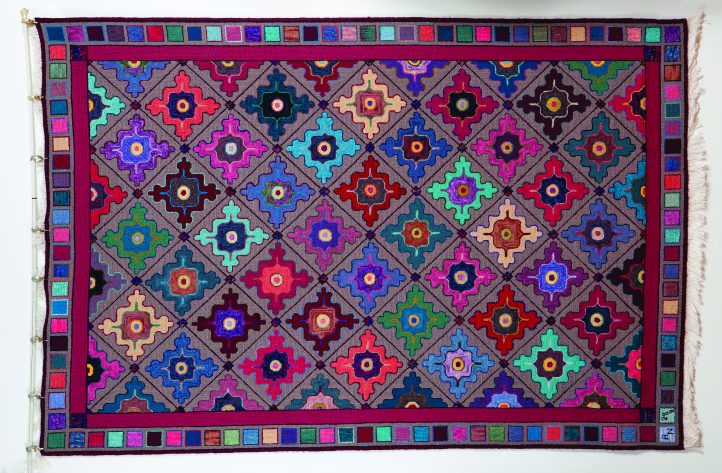
Gemstones Around Medallion Shapes, 62″ x 42″, #3-cut wool on monk’s cloth. Designed by Ruth R. Hall, adapted and hooked by Ardemia Negro, North Hollywood, California, 2009. This rug was a red ribbon winner at the Los Angeles County Fair.
As a young girl growing up in pre-war Italy, my mother, Ardemia Negro, was taught the fine arts of sewing and fiber crafts. She learned embroidery, fine hand stitching, crewelwork, crocheting, knitting, and dressmaking. When my two older sisters and I were growing up in Brooklyn, New York, we would come home from school to find, as if by magic, an array of curtains, embroidered tablecloths, linens, crocheted collars, and perhaps most memorably, an assortment of knitted black shawls that covered the flowing black habits of almost every Sister of Mercy we knew. Each shawl was knitted with a unique pattern that my mother designed to fit the personality of its wearer. Her talent for design later flourished in her hooking.
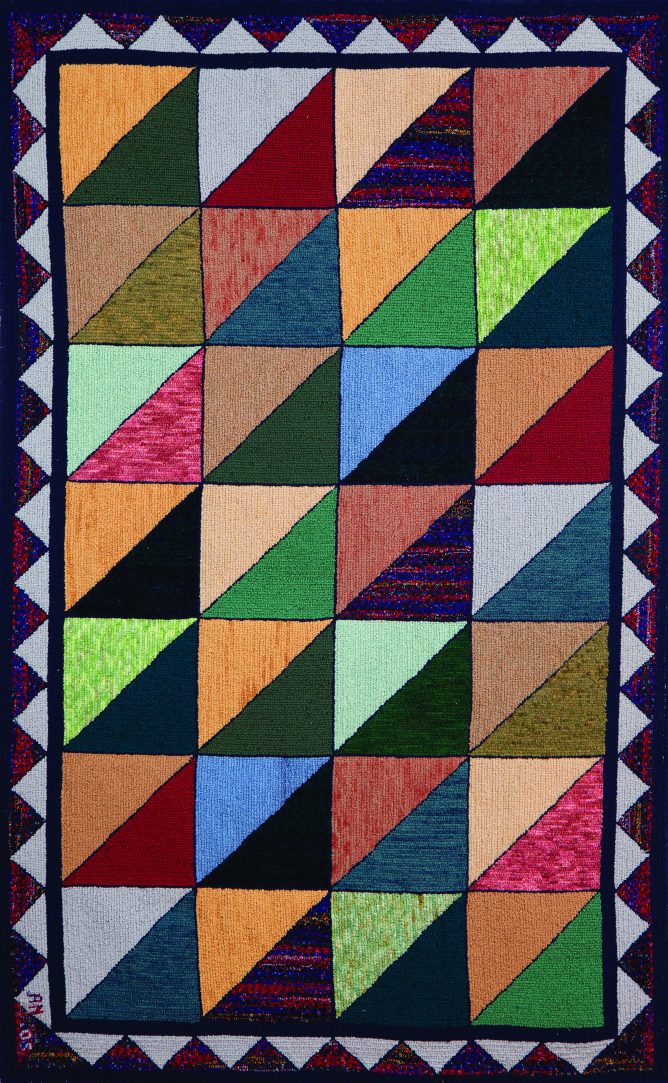
Colored Triangles, 48″ x 30″, #3-cut wool on rug warp. Designed and hooked by Ardemia Negro, North Hollywood, California, 2005. The different values for each triangle create a dynamic visual tension.
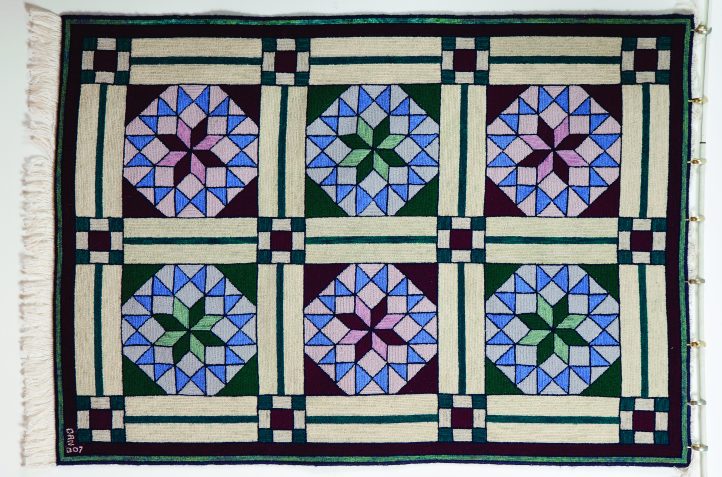
Dante’s Stained Glass, 35″ x 49″ with 2″ fringe, #3-cut wool on monk’s cloth. Derived from a Festival Star quilt design and hooked by Ardemia Negro, North Hollywood, California, 2007. My mother finished this rug just before my father died on New Year’s Eve.
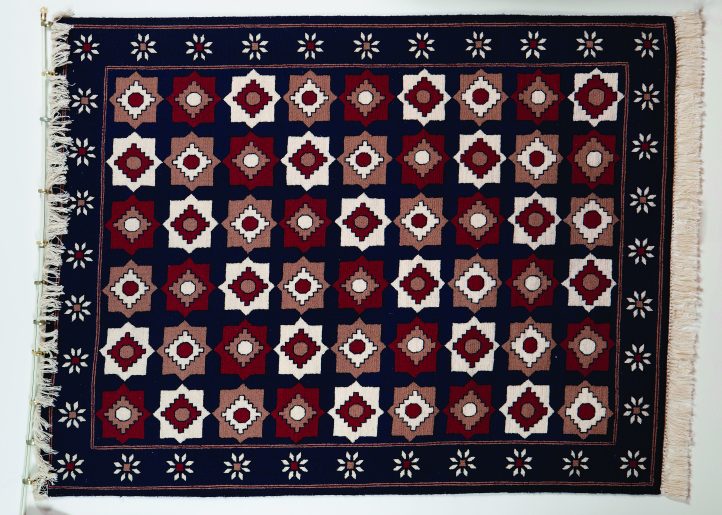
Detail from Double Cross Variation, 46″ x 59″ with 2″ fringes, #3-cut wool on rug warp. Designed and hooked by Ardemia Negro, North Hollywood, California, 2003. Ardemia used this limited palette for maximum effect.
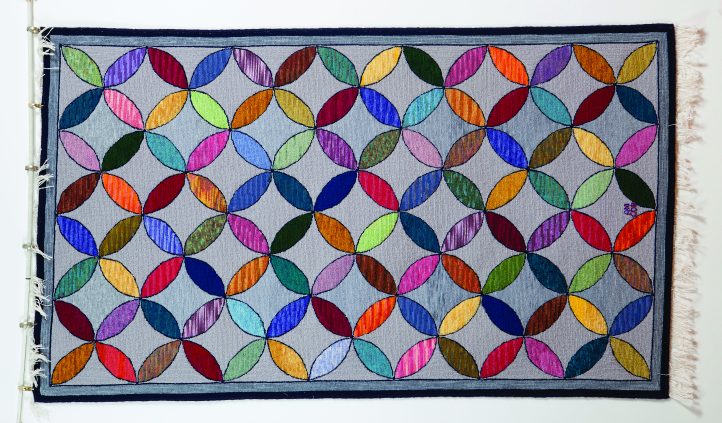
Detail from Circle Games, 591/2″ x 351/2″ with 2″ fringe, #3-cut wool on monk’s cloth. Designed and hooked by Ardemia Negro, North Holly-wood, California, 2008. After my father’s death, I was worried that my mother would give up hooking. This joyous riot of color and shape wildly proclaims an embrace and reaffirmation of life and its creative endeavors.
When I went away to college, my mother started looking for another creative outlet to fill her empty nest. A good friend of hers, Marguerite Rossetto, was a member of the Women’s Club of Great Neck where she was enjoying rug hooking classes. The teacher, Jo Parker, had a keen eye for aptitude, and Ardemia asked for a private lesson to see if hooking was a hobby she would like to pursue. After showing Ardemia the basic techniques, Jo gave her some wool and a small butterfly pattern on burlap. “Not everyone is a hooker,” Jo declared.
“Hook this using your own colors and bring it back when you’ve finished, and we’ll see.” Always one to rise to a challenge, Ardemia hooked the butterfly and brought it back the following week. When Jo looked at it, she exclaimed, “You are more than a hooker… I’ll be happy to teach you!” The butterfly was turned into a pillow, and Ardemia became a hooker.
Ardemia embraced the life of a rug hooker and relished the many jokes and humorous anecdotes that surround the craft of hooking. One day the mail carrier rang the doorbell at Jo Parker’s, requesting her signature on a package. Her daughter answered the door and said, “My mother can’t come to the door right now; she is in the basement dyeing.” The stunned mailman backed away stuttering, “Oh, oh, I… I am so sorry!” Many years later, when Ardemia was living in California, another circle of rug hookers called the Hug Rookers, celebrated her 83rd birthday with a “hooker party,” complete with a trophy, an outfit of stiletto heels, fringed miniskirt, red and black bustier and a purple boa, crowning her the grand madam with a red and purple tiara! This jovial camaraderie provided the encouraging environment in which Ardemia’s profound artistry grew to encompass a fascinating spectrum of styles.
Ardemia’s stylistic explorations began in the early 1970s with hooked pocketbooks and chair cushions, and then progressed to more ambitious endeavors. She hooked three 10′ long runners with an identical pattern and completely different color schemes reflecting her daughters’ personalities.
Intrigued by the Oriental rugs in the homes of her friends, Ardemia decided to make one for her own living room. She did her homework, studying the patterns, colors, and symbols of this style. Her efforts resulted in five 5′ x 7′ Orientals of different patterns and color schemes and, most spectacularly, a 9′ x 12′ Pearl McGown Mini Persian. Whereas most people stop hooking at the innermost border, Ardemia hooked every single border in the design. She had been warned that such a project would take upwards of 10 years. The rug was completed in 1984—it had taken her only 5 years! For many years after that, everyone who came to the house refused to walk on this beautiful rug, even though it was in the center of the living room, which made for some interesting traffic patterns in our household.
After the Orientals, Ardemia was drawn to geometric designs, and she became recognized for her precision and perseverance. After completing the border of one of the large geometric patterns she had ordered, she realized that the stamped pattern was crooked. Not wanting to rip out the work she had already done, she corrected the pattern by counting every single space as she hooked. The completed rug is perfectly straight and parallel.
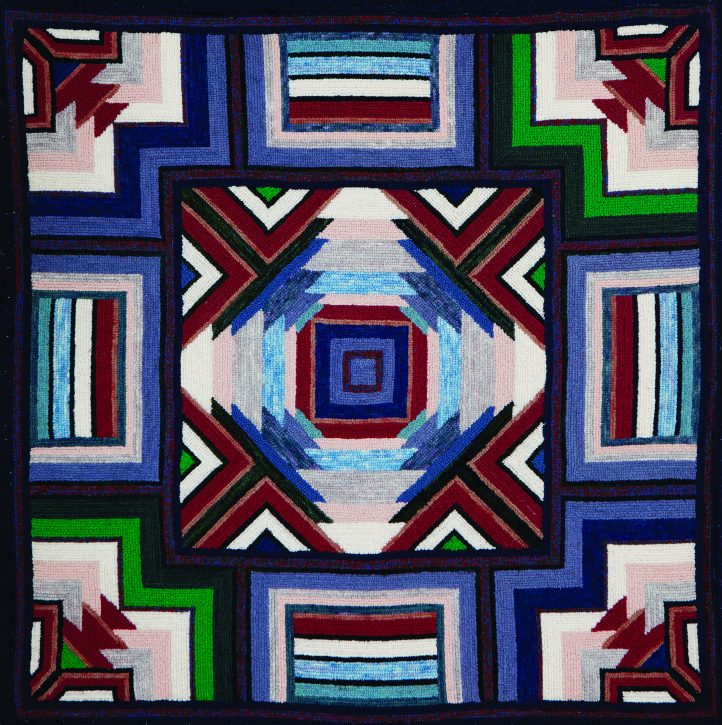
Diamond in a Square, 311/2″ x 311/2″, #3-cut wool on monk’s cloth. Adapted from a quilt pattern and hooked by Ardemia Negro, North Hollywood, California, 2008. This rug was a blue ribbon winner at the Los Angeles County Fair.
Using simple geometric shapes and design elements from quilting, Ardemia spent the next few years designing the rugs she hooked. Because of her exquisite sense of color and juxtaposition of shapes, her rugs have depth and a three-dimensional quality. Ardemia used a Puritan frame and worked only with a #3 cut. Each loop is exact and her rows are mathematically precise. She hooked forward and backward, never turning her work as she came to the end of a row. This created a slightly opposite slant to each row and gave the background dimension and texture more often achieved through swirling and varying the direction of the loops. Her precision was a result of her total efficiency of hand movements, the economic use of time and materials, and the steady flow of work which she never interrupted, not even to cut the ends of the wool strands until each work session was complete.
When Ardemia entered one of her original designed rugs in the Pomona County Fair in California, a woman was overheard complaining to a friend how unfair it was to allow machine-made rugs in the exhibition. As it happened, one of Ardemia’s colleagues, Karen Hubbard from the Hug Rookers, was standing next to the woman and informed her that she knew for a fact that the offending rug was an original and all done by hand with a #3 hook, because she had watched its maker hook it!
The last rug Ardemia started was an Oriental, which she began a few months before her death on April 1, 2010. Just as some great symphonies are left unfinished, my mother completed the center medallion, but the rest of this exquisite Oriental is left undone.
She leaves behind an enormous body of work, well over 50 rugs. She was elegant, courageous, loving, and thoughtful in life; in art she strove for perfection and beauty. My sisters and I are planning an exhibition of her many rugs in California as a fit-ting tribute to her lifelong artistry.