
 Give a Gift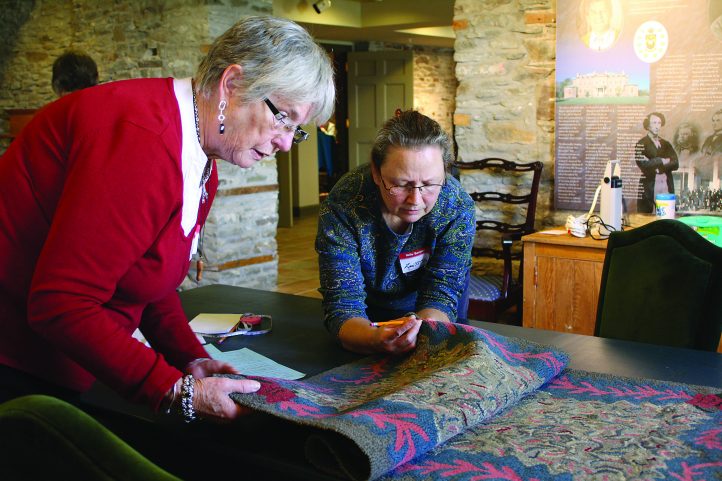
Doris and volunteer mat examiner Lois MacDonald, who works at Kings Landing Historical Settlement near Fredericton in the museum’s costume collection, review a rug submitted to the preservation program.
PHOTOGRAPHY BY AUDREY NORMAN
Doris Norman is not only a skilled artisan and creator of inspiring and beautiful rugs, she is a talented, accredited Pearl McGown and Rug Hooking Guild of Nova Scotia (RHGNS) teacher who has helped countless people to pick up a hook and find themselves in their creations.
Doris, who was born in New Brunswick, Canada, and lives in Fredericton, the capital city of that province, teaches rug hooking across the United States and Canada. She specializes in Celtic art, William Morris, Jacobean, realistic and primitive pictorials, Mayan/Peruvian art, stained glass hooking, and dyeing techniques. Her interest in the art all stems from her first rug hooking memory: “When I was a child in Black’s Harbour [New Brunswick], I remember seeing my grandmother Bradford’s rugs on the floor in the upstairs hall in her house.”
REACHING BACK
Doris pays tribute to her grandmother and the tradition of rug hooking by working to document and save the history of rug hooking in New Brunswick. She, Judith Morison, and Line Godbout, with many dedicated volunteers, formed the New Brunswick Mat Registry (NBMR) in partnership with the New Brunswick Museum, where the public can bring any New Brunswick–made rugs, 25 years old or older, to be inspected, documented, and photographed.
“To tell the New Brunswick story,” Morison said, “we needed to ensure the whole story in New Brunswick was being documented. Line Godbout, another accomplished fibre artist, had the same dream, and with her dynamic leadership, we welcomed our Acadian partners into the project.”
The registry could now reach out to all areas of the province with volunteers interviewing mat owners in English or French, documenting their stories in their own language. New Brunswick is Canada’s only officially bilingual province, and according to a recent population census, 65% of New Brunswickers are English, 33% are French, with a cross-section of 30% self-declared bilingual; 5% are Mi’kmaq or Malecite—First Nations.
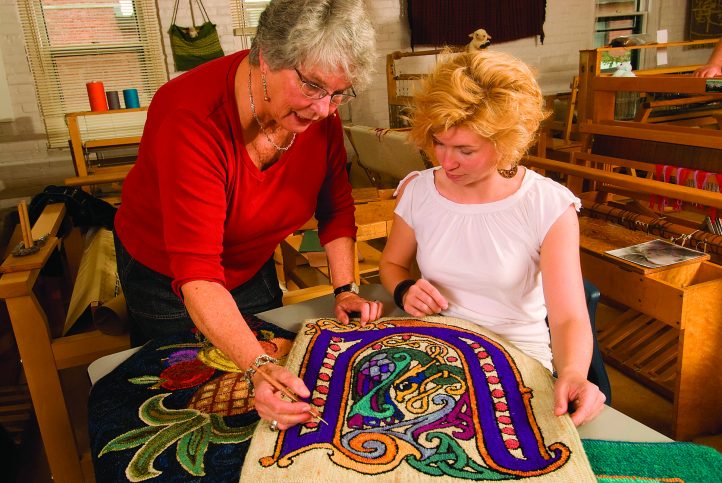
Doris and one of her students take part in edVentures.
“We have had 10 registries held in all areas of the province: now over 300 mats registered, with more than 1200 images,” Morison said. “There is a waiting list of over 100 mats from all around New Brunswick, waiting for a registry in their area.”
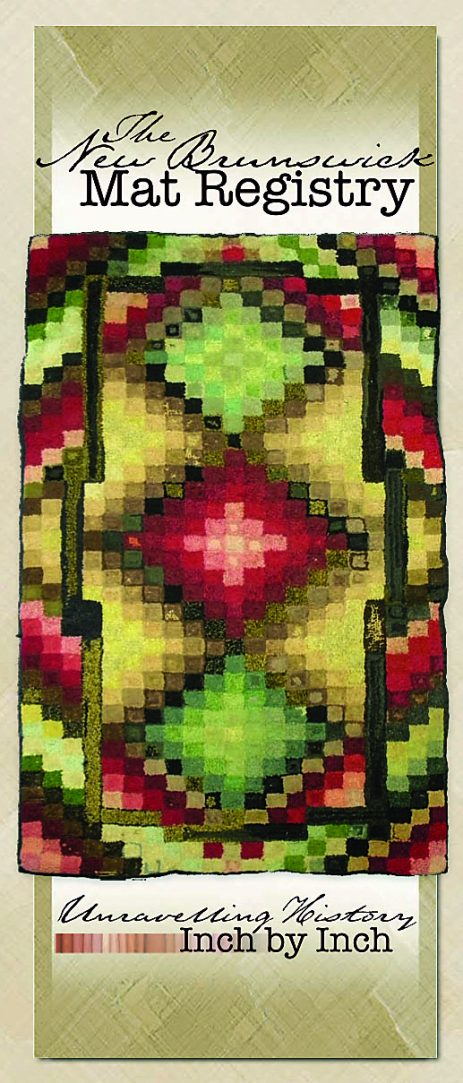
NBMR brochure cover: Inch Mat, Boston Sidewalk. Hooked by Mrs. O. B. [Liza] Davis, Grand Falls NB, circa 1915. JAN TRITES DELONG/NBMR/WWW.MATS-TAPISNB.COM
“My philosophy is simple. [Students] should enjoy creating something beautiful that helps them feel fulfilled and rewarded. It should be a relaxing, enjoyable learning experience for teacher and students.”
REACHING OUT
Rug hooking is also reaching the public in New Brunswick in a different way, since 2008 when edVentures was launched in Fredericton. It is billed as a learning/crafts workshop vacation and features more than 75 workshops in jewelry and metalwork, textile arts, visual arts, photography and writing, and heritage and traditional crafts.
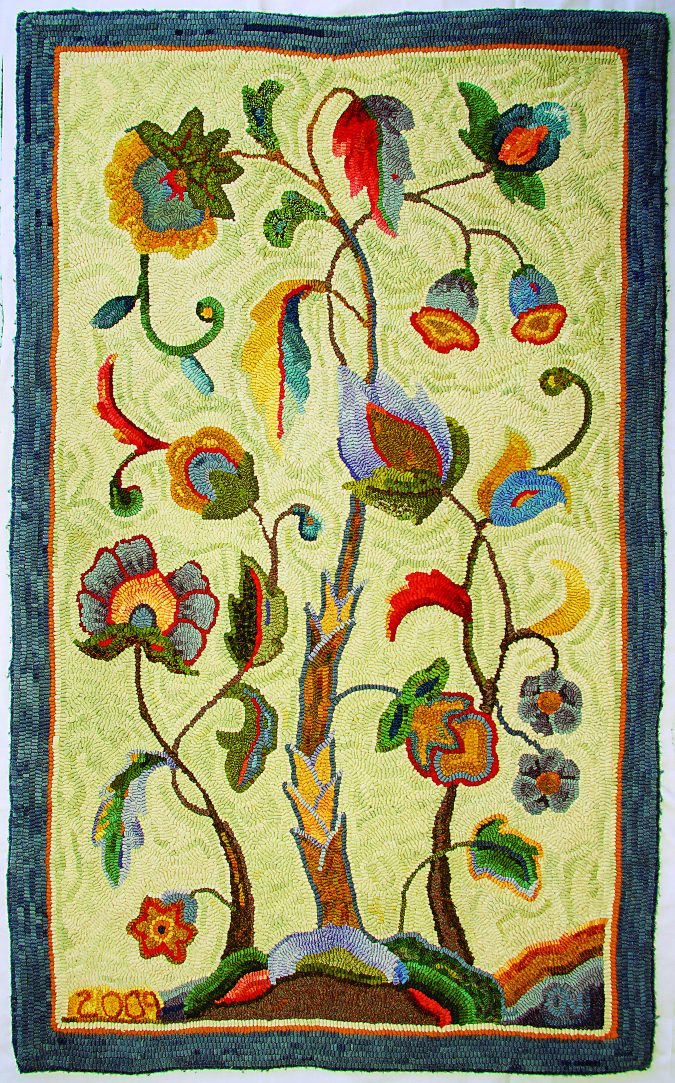
The Tree of Life, 28″ x 46″, #7-cut wool on burlap. 1930s Garrett Brothers Bluenose design hooked by Doris Norman, Fredericton, New Brunswick, Canada, 2009. Pattern sold by Rags to Rugs in Pictou, Nova Scotia. Jacobean designs originated in India—the Tree of Life variations alone are endless, with rich contrasting colors. When explorers brought back fabrics and embroidery with these fantastic designs, needleworkers in England and France adapted them in their own work, sometimes adding some of their more familiar flowers. When hooking these types of rugs, Doris researches history thoroughly, absorbing the lore and evolution of each design, to create her own designs in wool. Jacobean designs created in Britain in the early 17th century were carried to America by British colonists and have had various revivals of interest since.
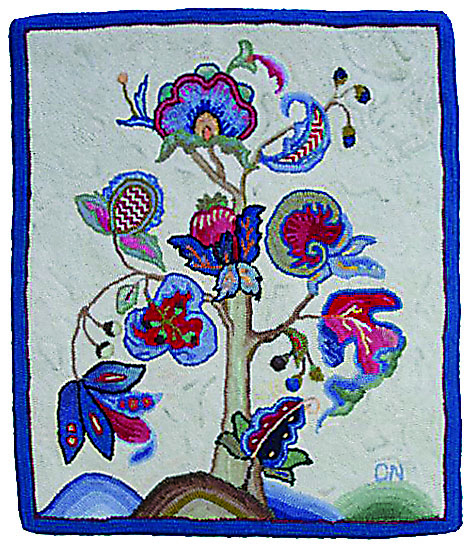
Jacobean Tree of Life (small), 22″ x 26″, #6-and 7-cut wool on linen. Designed and hooked by Doris Norman, Fredericton, New Brunswick, Canada, 2007. This original Tree of Life design incorporates old Jacobean motifs and various hooked stitches.
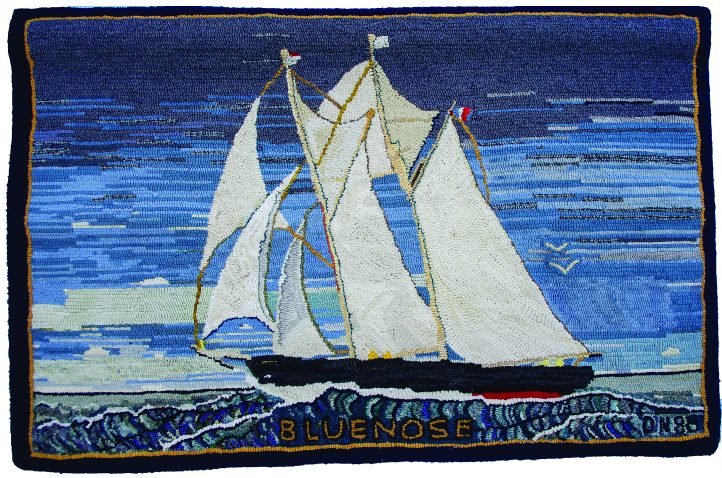
Bluenose, 42″ x 28″, hand-cut and #6-cut wool on burlap. Designed by Garrett Brothers and hooked by Doris Norman, Fredericton, New Brunswick, Canada, 1988. This rendition of a famous Canadian schooner incorporates reclaimed fabrics and dyes. A favorite of her late husband, this rug hung in his law office for 25 years. Wool for the sails was hand cut, and the remainder was hooked in #6 cut. It is an early Garrett Brothers’ design, Rags to Rugs, Pictou, Nova Scotia.
Doris was the first model instructor—a “guinea pig” in her words—for the program. During its development, Doris proposed a suitable rug hooking course and then worked through the logistics with Fredericton staff members as trial students. Her participation allowed the planning of the program to be more realistic and therefore for it to go more smoothly, once launched to the public.
“It is important that students consider themselves the artist or creator; I am merely the enabler.”
Having recently lost her husband, Doris continues to be touched by the generosity and kindness of the rug hooking community, as notes of condolence keep coming in, some from people she has never met, others from colleagues and students, old and new. “The beauty of [rug hooking] is that you meet so many fascinating and wonderful people.”
Doris Norman’s art has been featured in Canadian Living magazine and Rug Hooking magazine, and is included in the New Brunswick Beaverbrook Art Gallery’s permanent collection, as well as in many private collections. Doris has taught at Nova Scotia schools in Truro and Cornwallis for many years, as well as the Prairie Harvest, Trent, Newfoundland and Labrador schools, Hooked in the Mountains, and Friends by the Sea in Oregon. As well as the edVentures summer courses, Doris teaches extensively throughout New Brunswick. Doris has been a certified RHGNS Teacher since 1985 and Pearl McGown instructor since 2007 and belongs to ATHA, TIGHR, RHGNS, and OHCG. Her blog is Doris Norman Rug Hooker at http://dorisrughooking.blogspot.ca.
“Students come to schools, workshops, and private lessons for various rea-sons—I try to be sensitive to their needs; most come because it is a learning vacation. They want to learn something new, meet old friends, rest, have fun, and ‘just plain get away from it all’.”
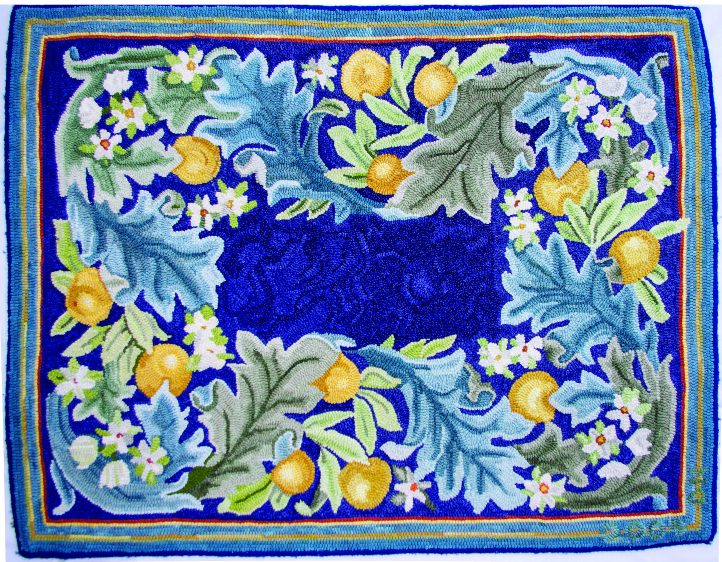
Orange Border William Morris, 36″ x 24″, #4- and 5-cut wool on linen. Adapted by Doris Norman, with permission, from Beth Russell. Hooked by Doris Norman, Fredericton, New Brunswick, Canada, 2004. When studying the William Morris oeuvre, Doris found Beth Russell’s book, William Morris Needlepoint, to be very useful. She was taken by the Orange Border design, meticulously true to the original tapestries, and emailed the author for permission to use it. Enthusiastic permission came the next morning. Doris is adamant that permission must be sought and granted if one is to use someone else’s design, whether it be found on the Internet, at a show, or in a book or magazine; it is never acceptable to “borrow” another’s work without permission. She has found that many artists are more than happy for someone to interpret their art in wool, with accreditation, of course. Beth Russell studied the prodigious William Morris fabric and tapestry archives at London’s Victoria and Albert Museum to faithfully depict his designs; she stipulates and supplies Appleton tapestry and crewel yarns for her patterns and kits. Being a member of the Fredericton Guild of Fibre Artists, Doris referred to their complete set of Appleton’s 415 wool colors and developed dye formulas to replicate Beth Russell’s colors for her William Morris courses. Doris also prefers to present designs consistent with their history, including colors.
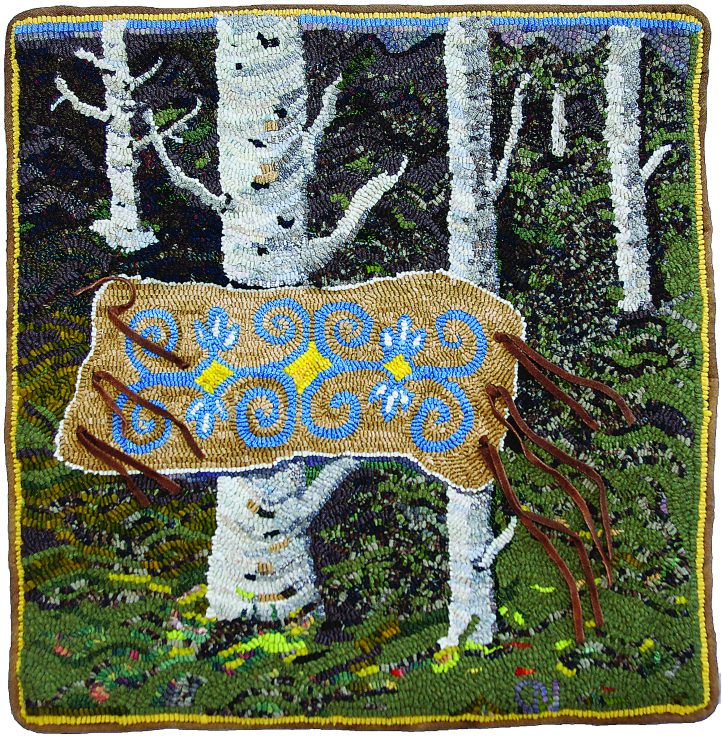
Art of the Americas—A Malecite Birch Bark Armband, 21″ square, #4- to 6-cut wool on linen. Designed and hooked by Doris Norman, Fredericton, New Brunswick, Canada, 2011. Doris researched and hooked this rug in preparation for her Art of the Three Americas course. “The North American Indians have intriguing art, as do the Inuit. This course is a great opportunity to learn the history and art of the Mi’kmaq, Maliseet, Iroquois, Navajo, etc. The Arts of the Mayan, Peruvian, and other women of Central and South America are vibrant with the natural colors of their plants and stones. There are extraordinary designs in all of these cultures. The birch bark and leather armband, in the foreground, was worn on the upper part of the arm. It was tied on with leather strips of fiber threads. The double-curve design was a typical Mi’kmaq decoration. She says, “The armband was in the New Brunswick Museum and was printed in ‘Our New Brunswick Story,’ my grade five school book. I created the rest of the design; I thought it was appropriate to have the armband flying through a stand of birch trees.” Malecite (also Maliseet) are First Nations people living in northwest-ern New Brunswick and eastern Quebec, Canada. The Mi’kmaq are an aboriginal people living in the Atlantic provinces of Canada.
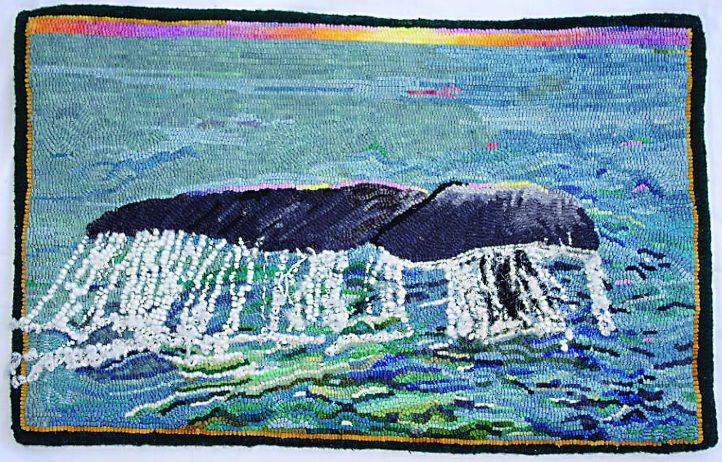
Whale of a Tail in the Bay of Fundy, 24″ x 15″, #4-and 5-cut wool fabric, yarns, and crystal threads on linen. Designed and hooked by Doris Norman, Fredericton, New Brunswick, Canada, 2011. “The majority of the Earth’s surface is covered with water. It is the cradle of life and at its deepest, very mysterious. We may hook the realistic world of fish, animals, the sea’s flora and fauna or the ancient sailor’s world of strange creatures, monsters, mermaids, and sea sprites. The underwater ‘fire’ of the jellyfish and other phosphorescent animals, the ‘purses washed up at high tide’ (the property of mermaids and mermen) are all subjects for our hook and imagination. This is a salty course with verse, story, and music.” Doris hooked this rug as an example for her newest workshop, taught at Newfoundland and Labrador and RHGNS annual rug schools, “Under the Sea,” of which she says: “This is a fun course which encourages students to create a realistic or fantasy underwater world of hooked fabrics and/or yarns. The class is for all levels of experience, all cuts of wool; originals and commercial patterns are welcome.”
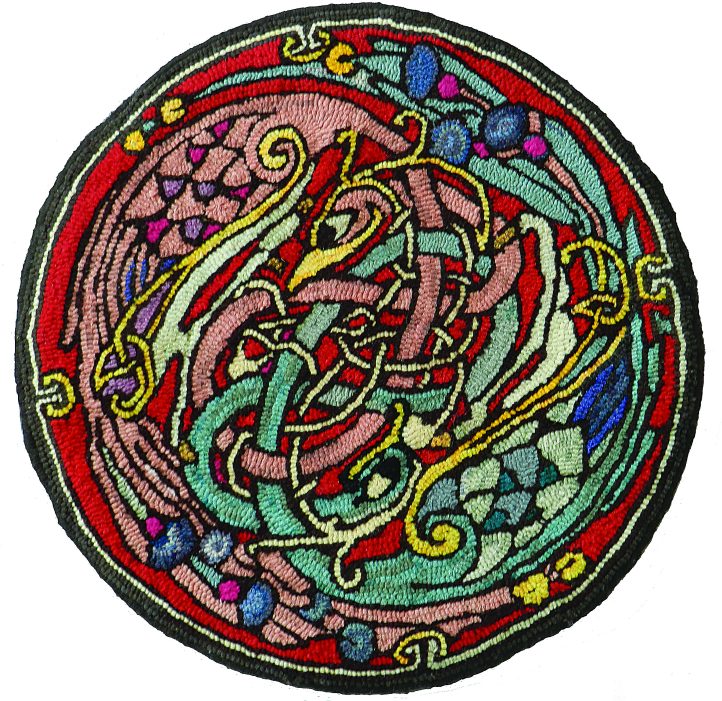
Love Knot, 19″ diameter, #3- and 4-cut wool on burlap. Designed by David Rankine for Rittermere-Hurst-Field and hooked (colors as found in the Book of Kells) by Doris Norman, Fredericton, New Brunswick, Canada, 1996. A world of wonder opened up for Doris in 1989 when she hooked a small knot design as another study aid for her classes. She then delved more deeply into the rich world of Celtic art and history, which led her to study Celtic knots more thoroughly and then the stupendous Book of Kells (Trinity College Library, Dublin, Ireland) with its rich ornate ornamental lettering. Along with Riverdance, Celtic music, and Celtic ornamentation, all things Celtic are now very popular, but Doris was ahead of the curve, recognizing the sinuous lines in Celtic knots and illustrated letters as being ideal for rug hooking.
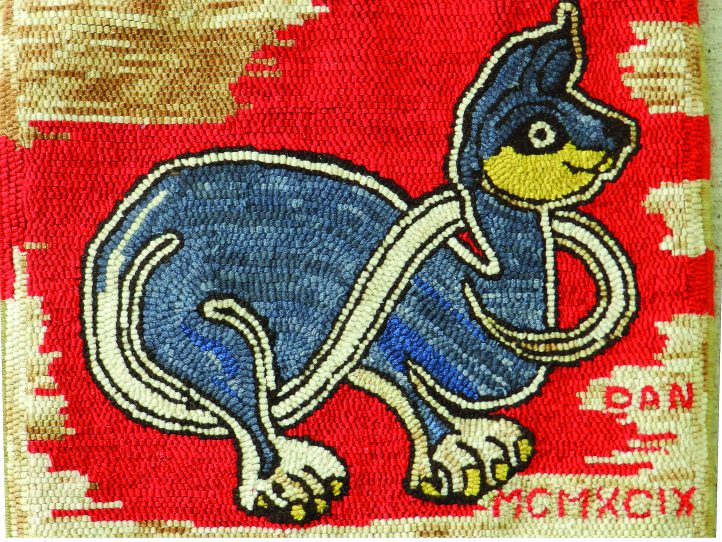
The Comical Celtic Cat, 151/2″ x 121/2″, #4- and 5-cut hand-dyed wool on burlap. Designed and hooked by Doris Norman, Fredericton, New Brunswick, Canada, 1995. The whipping duplicates the change of color from the design.