
 Give a Gift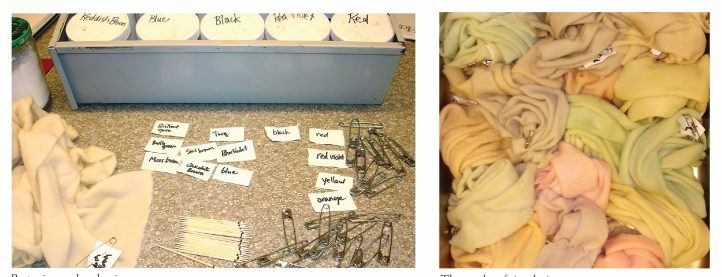
Left photo: Preparing to dye the tints. Right photo: The results of tint dyeing.
In paint mixing, a tint is a tiny bit of color with lots of white added. In dyeing, white is our natural-colored wool, and when we add the tiniest amount of dye color to it, we get surprising results. These are our tints and we love them. Having a small selection of these in your stash means you have a ready supply of whitecaps, skin tones, apple shine, and fog. How can you resist?
I use a funny way to measure the dye for tints. It works for me, and I hope you will find it useful. I start with a ready supply of round toothpicks. I mark each toothpick 3/8″ up from the point. To measure the dye, I simply dip a toothpick into the dry dye and whatever amount of dye sticks to the wood is thrown into my dye bath to dissolve. Some of the dyes will not adhere to a dry toothpick so I dampen the wood, let any extra water drip off, and dip only the very point of the toothpick into my dye jar.
Let’s talk about wool for a minute. I used natural wool for these samples. ‘What about white?’, you might be thinking. I have white wool in my stable, but I only use it for dyeing the cool side of the color wheel—violet, blue, and green—if I’m looking for brighter results. These are the only colors that will be dulled by the slight yellow cast of natural wool. Sometimes you may want that dull look; if not, use white wool. For icicles or newly fallen snow, dyeing blue, green, or violet over white is fantastic.
The wool dyed with these formulas will appear lighter than they do in the sample photos. They are a real pleasure to look at all placed together. It is always surprising to see the results despite the minute amount of dye I used. I dyed each sample over 1/16 yard of wool.
Be careful to start your process with very clean utensils and pans. Light colors are easily influenced by any bit of dye left over from the last dye session.
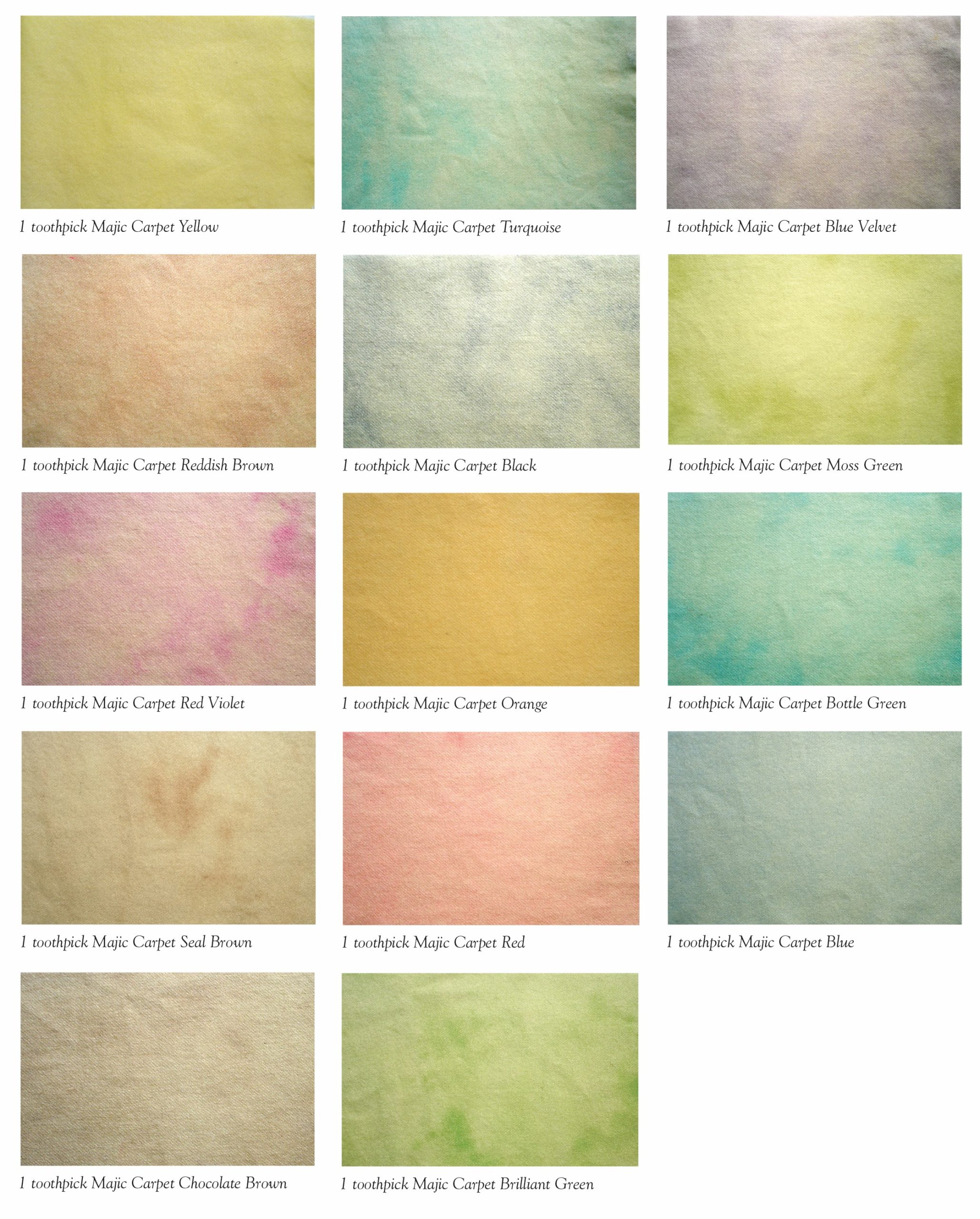
Row 1 (from left to right): 1 toothpick Majic Carpet Yellow, 1 toothpick Majic Carpet Turquoise, 1 toothpick Majic Carpet Blue Velvet. Row 2 (from left to right): 1 toothpick Majic Carpet Reddish Brown, 1 toothpick Majic Carpet Black, 1 toothpick Majic Carpet Moss Green. Row 3 (from left to right): 1 toothpick Majic Carpet Red Violet, 1 toothpick Majic Carpet Orange, 1 toothpick Majic Carpet Bottle Green. Row 4 (from left to right): 1 toothpick Majic Carpet Seal Brown, 1 toothpick Majic Carpet Red, 1 toothpick Majic Carpet Blue. Row 5 (from left to right): 1 toothpick Majic Carpet Chocolate Brown, 1 toothpick Majic Carpet Brilliant Green.
In order to remember which sample was which, I used a Sharpie to print the dye name on a Tyvek label and pinned that to each sample.
Our dye kitchens are a cornucopia of delights. I hope you jump in and experiment with your dyes. They all will give you wonderful results as you use this method for creating tints. Imagine any of these tints as a background for a floral or as a pastel sky. . .
Oh, I can’t wait to cut them up and start hooking!