
 Give a Gift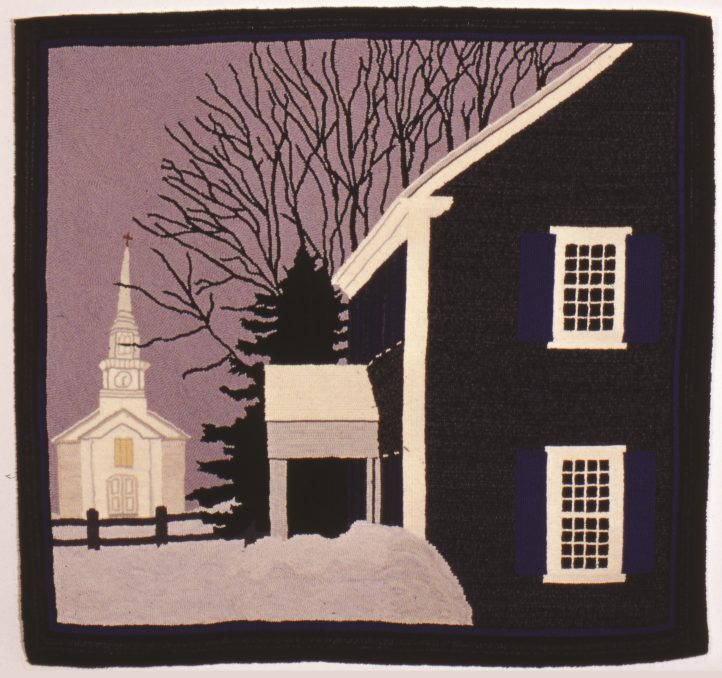
Faith of Our Mothers, 47″ x 50″, #4- and 6-cut wool on linen. Designed and hooked by Emily Robertson, Cambridge, Massachusetts, 2002.
TEXT AND PHOTOGRAPHS BY EMILY ROBERTSON
A friend of mine once said that theology is about naming, and that naming has power—the power to shape the way people perceive their lives and their world. With that in mind, I have selected seven of my theology rugs to write about in this article. All people believe something about the meaning of life. You and I may differ about the details, but I think we can all enjoy the fact that deep meaning can be conveyed through our art of rug hooking.
Faith of Our Mothers
Faith of Our Mothers is a special favorite of mine. I was inspired by a blizzard that transformed our neighborhood into a glorious winter panorama of grays and whites. It is rare for this much snow to fall on Cape Cod, and I was dazzled by the resulting shift in the color spectrum.
The house in this rug belongs to my brother-in-law and his wife, across the street from me. I was taken by its starkness and how dark the siding became because it was wet. The pine tree is right next to their house, but for the purposes of good composition, I added the fence and the church.
I loved the challenge of working with such a limited pallet and spent a considerable amount of time dyeing grays for the snow and the buildings. It was a challenge to use so much gray, white, and grayed-white wool in the same composition and not lose all contrast.
The Christa
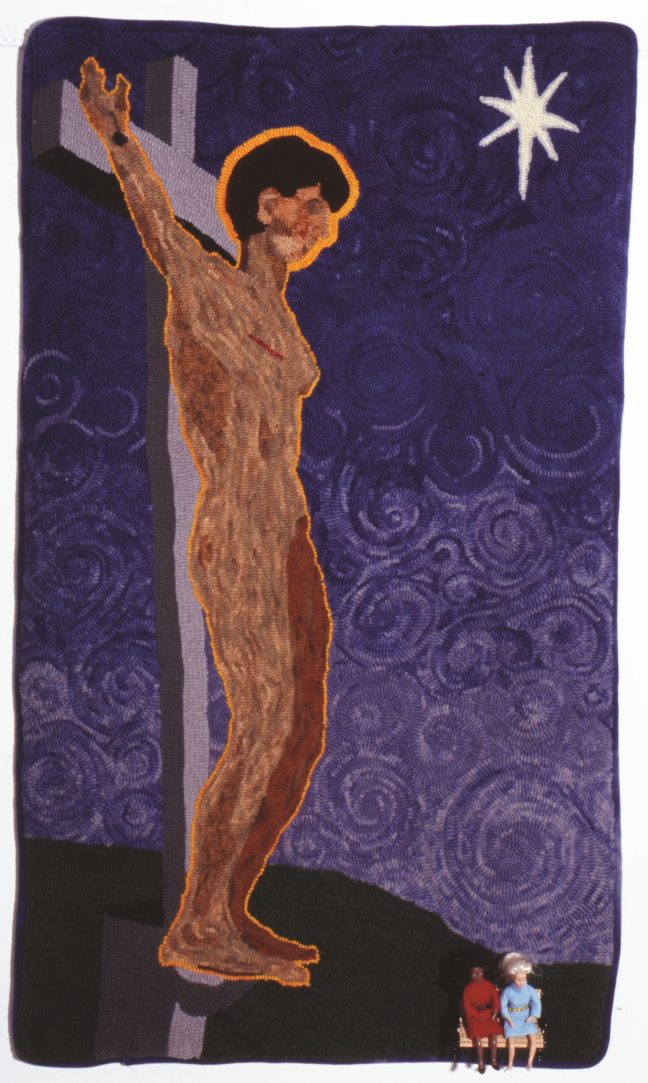
The Christa, 50″ x 30″, #4-and 6-cut wool, plastic dolls, and park bench on linen. Designed and hooked by Emily Robertson, Cambridge, Massachusetts, 2006.
While I was attending seminary, my classmates asked me to make a Christa. I had never thought that I would use imagery like this, but it has turned out to be one of my most positively regarded works. I gave the female figure a red breast cancer scar rather than a wound from a spear. The small figures of the two dollhouse women sitting on a park bench is a reference to just who the women at the foot of the cross were. Were they blond high Renaissance women or, much more likely, northern African women?
I swirled the dark sky to remind the viewer of the tempestuous day of Calvary, but then added the star of Bethlehem to refer back to the original hopes and dreams of the Christian story.
Second Samuel: 13, 33
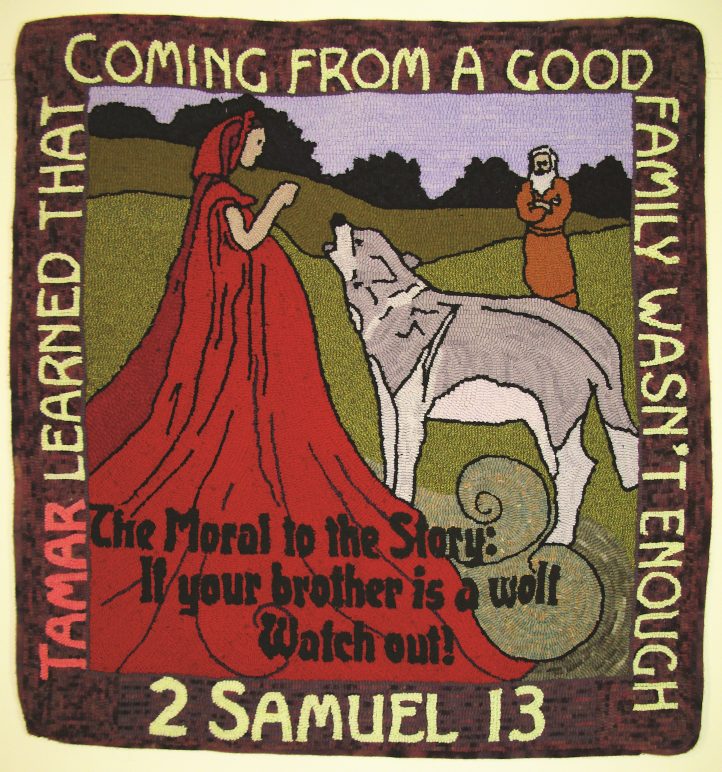
Second Samuel: 13, 33″ x 36″, #4-and 6-cut wool on linen. Designed and hooked by Emily Robertson, Cambridge, Massachusetts, 2007.
Second Samuel 13 originated in my Hebrew Bible course. If you have any interest in really knowing the full meaning of this image, I recommend that you read this chapter of the Bible yourself. When I was studying it in seminary, I thought it one of the most brutal and cruel stories that I had ever encountered. And I wondered who benefits from having this story in print? I was angry and sad to think that a daughter of a king could be raped by her brother and then shunned by her father. Unfortunately, victims of brutality are still being punished for crimes. Blaming the victim. . . we have all heard about this.
I wanted to engage and attract viewers, so I chose my colors with that in mind. When I displayed this rug in a show, my theology professor said I had gotten it “just right.”
Who Cooked the Last Supper?
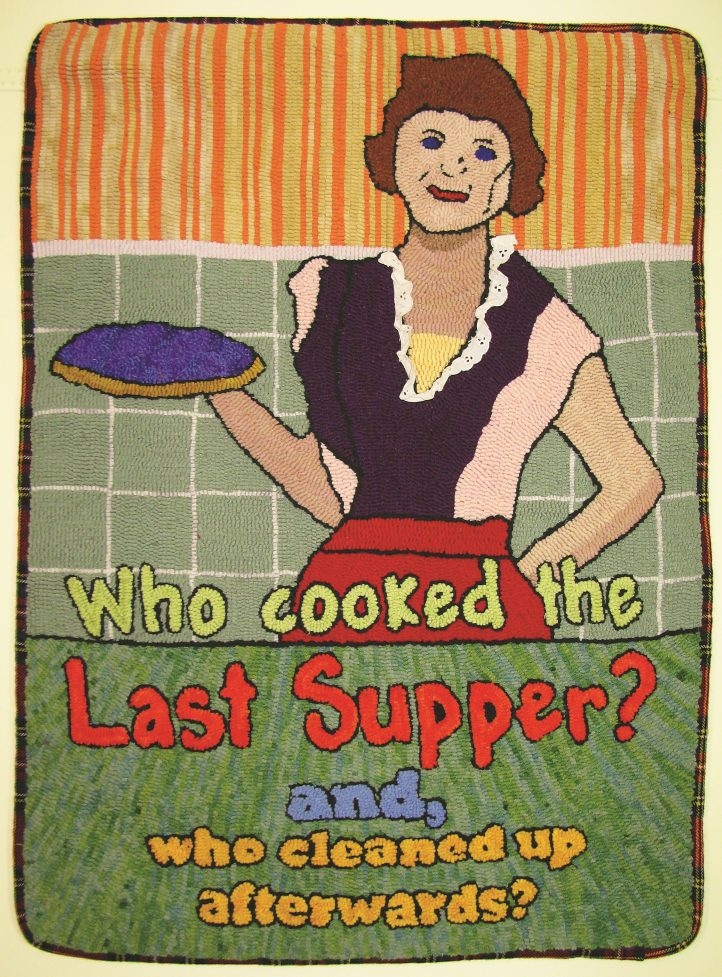
Who Cooked the Last Supper?, 36″ x 26″, #4-and 6-cut wool and cotton lace on linen. Designed and hooked by Emily Robertson, Cambridge, Massachusetts, 2006.
When one of my seminary classmates posed the question of who cooked the Last Supper, I knew I had a great subject for a rug. I wanted to make this light-hearted, so I used what I think of as a 1950s style. The edging for this rug is a tartan, to capture the ’50s feeling. I ran out of enough wool to finish the background on the lower part of the piece and had to add “and who cleaned up after-wards?” to compensate. This rug never fails to bring a smile to the women who see it.
Mary Magdalene
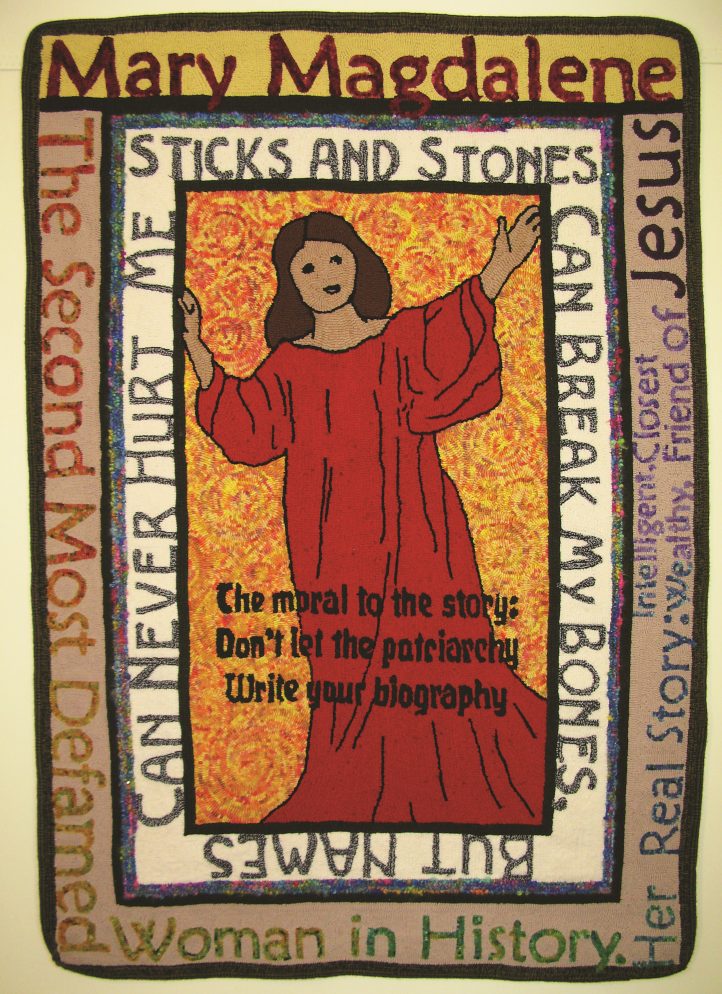
Mary Magdalene, 60″ x 42″, #4- and 6-cut wool on linen. Designed and hooked by Emily Robertson, Cambridge, Massachusetts, 2007
One of the strongest encounters I have ever had with my muse brought me the idea, composition, and color planning for Mary Magdalene. In an instant as I walked outside my church, everything you see in this rug was in my mind, and all I had to do was draw it and hook it. I was astonished by the concept, the colors, and the words to this piece, because the instant before I “saw it,” I had been wondering just what I would be hooking next.
Mary Magdalene was made into a postcard for a show I had and has become a very popular image among all the feminists of faith I know. I used some beautifully dyed yarn for part of the border, and that softness adds depth to the image.
Eve
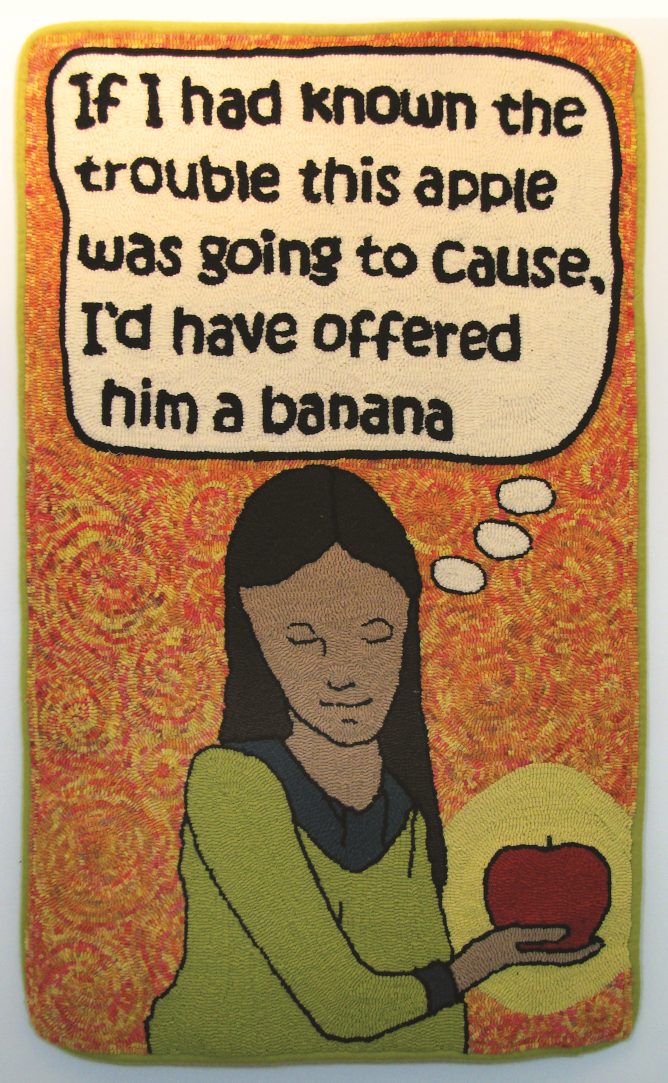
Eve, 44″ x 27″, #4- and 6-cut wool on linen. Designed and hooked by Emily Robertson, Cambridge, Massachusetts, 2008.
After I referred to Mary Magdalene as the second most defamed woman in history, I knew I had to do a piece depicting Eve, whom I consider to be the most defamed woman in history. I wanted it to be lighthearted, hence the cartoon nature of the image. Eve’s musing never fails to bring a smile or an outright laugh. I love putting unexpected humor into my work. Life can get very serious, and a good laugh counterbalances that quite well.
I used the same red wool for the clothing in Second Samuel 13 and Mary Magdalene and the apple in Eve. These pieces are often exhibited together, and I wanted to create a unifying effect.
Mary Regina
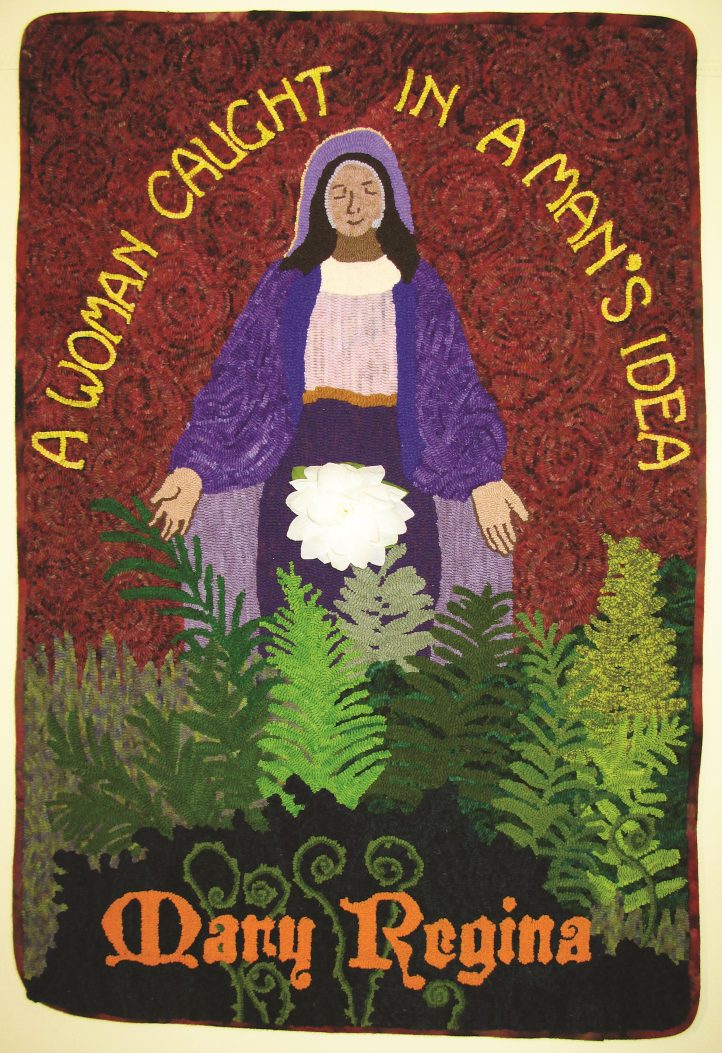
Mary Regina, 53″ x 36″, #4- and 6-cut wool and artificial lotus blossom on linen. Designed and hooked by Emily Robertson, Cambridge, Massachusetts, 2009.
Mary Regina is represented in her most traditional pose. I used a statue outside of our local Catholic church for inspiration. I have strong feelings about the role women have traditionally held throughout the history of Christianity, and I conveyed them in both the words of this rug and its imagery. Mary is standing among ferns to convey her earthiness, and an artificial lotus blossom located at her pelvis conveys the pureness and perfection of her role in history. The background is a deep red spot-dyed wool to remind the viewer of blood, of the effort of bringing forth life, and of the glorious passion needed to sustain it.